
Lagarde says Europe has built the tokenization pipes but still lacks the rules
The ECB president told bankers in Frankfurt that a single EU market for tokenized assets is within reach only if lawmakers agree common rules before rival platforms harden. The euro area’s own settlement link has just carried its first €1 billion bond.
In FocusTokenization & RWA8 flashes · 5 stories
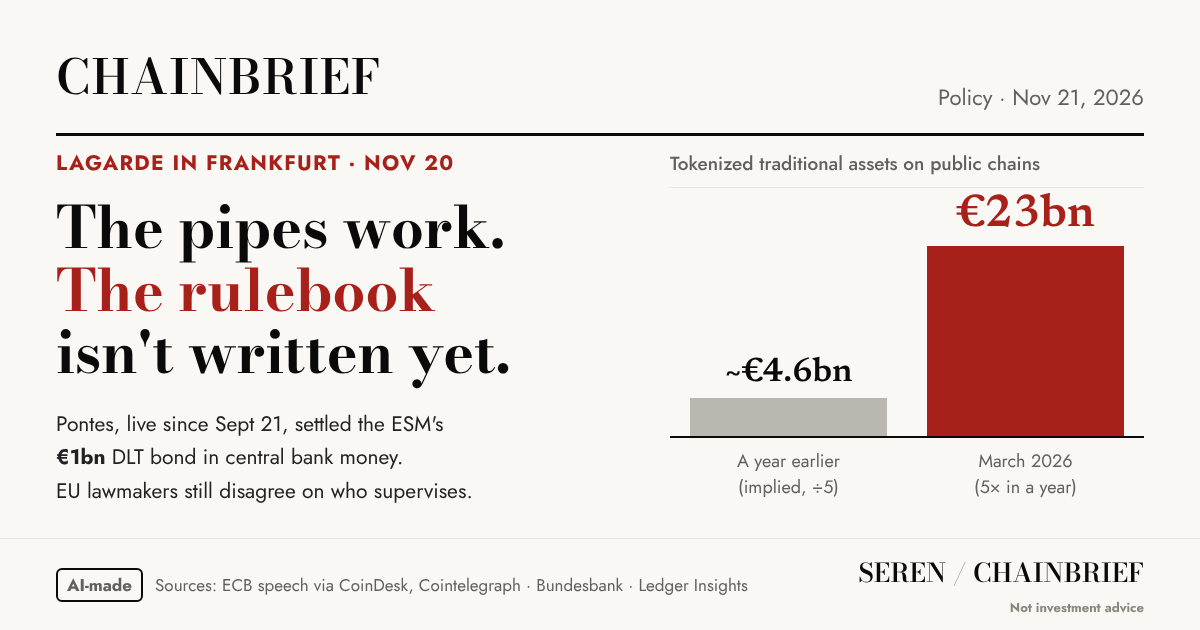
Earlier this month the European Stability Mechanism, the euro area's bailout fund, sold a €1 billion bond that existed only on a blockchain, and paid for it in central bank money. On Friday, Christine Lagarde used that deal to make a broader point to a room of bankers in Frankfurt: the plumbing for tokenized finance in Europe now works, but nobody has yet written the rulebook that would make it one market instead of many.
Speaking at the European Banking Congress on Nov. 20, the European Central Bank president said the global market for traditional assets issued as tokens on public blockchains stood at about €23 billion in March, five times its size a year before. That is still small next to Europe's bond markets. Her worry was about timing. If incompatible platforms grow up in different countries before the European Union agrees how they should work, she argued, stitching them together later will be much harder.
"Common rules will be needed too, and those lie with legislators," she said, according to CoinDesk and Cointelegraph. In other words, the ECB can build settlement infrastructure, but it cannot decide who licenses and supervises the trading venues that sit on top of it. Lagarde is due to leave the ECB in February, so this was one of her last big statements on the subject.
A €1 billion test run
The infrastructure she was talking about is called Pontes. The Eurosystem, the ECB plus the national central banks of the euro area, switched it on on Sept. 21. It lets a trade in a tokenized security settle against euros held at the central bank, the safest form of money in the system, instead of against a private token or a commercial bank deposit. According to the Banque de France's announcement, Pontes started with a core set of services, and longer operating hours and extra features are to follow in stages until 2028.
The ESM deal was its first real workout. The fund priced a three-year bond with a 3.375% coupon, maturing on April 8, 2030, and drew €2.2 billion of orders for €1 billion of paper, Ledger Insights reported. The securities were created on Clearstream's D7 ledger. The Bundesbank acted as issuing and paying agent, and the money side ran through Pontes into T2, the euro area's main large-value payment system. DZ BANK, HSBC, Santander and Société Générale led the sale. Per the Bundesbank, it was the first blockchain-based benchmark bond from a European supranational issuer settled this way.
The ECB plans to be a customer too. Also on Sept. 21 it said it had started preparatory work to put a small part of its own funds, the portfolio that helps pay its running costs, into tokenized securities, settled through Pontes. The first purchases would be euro-denominated debt from euro area governments, regions, agencies and supranational bodies. The Executive Board has not yet set an amount or a date.
For scale, that single ESM bond is about one twenty-third of the whole public-chain tokenized-asset market Lagarde described.
Brussels is still arguing over the referee
The rules Lagarde wants sit mostly in one bill. On Dec. 4, 2025, the European Commission tabled its Market Integration and Supervision Package, a set of proposals meant to make EU capital markets behave more like a single market. Two parts matter for tokenization.
The first is the DLT Pilot Regime, the EU's sandbox that lets trading and settlement systems run on blockchains under lighter rules. The Commission proposed raising its activity cap from €6 billion to €100 billion and dropping the time limits on permits, according to summaries by law firms DLA Piper and CMS. A system that outgrows the sandbox today has nowhere obvious to go.
The second is supervision. The Commission wanted the European Securities and Markets Authority, ESMA, to license and oversee every crypto-asset service provider under MiCA, the EU's crypto law, taking the job away from national regulators. Member states pushed back. When EU finance ministers agreed the key elements of the Council's position on Oct. 9, they limited ESMA's direct role to the most significant firms and asked for a two-year handover, according to Norton Rose Fulbright's Regulation Tomorrow blog and a KCEX summary of the Council's policy overview.
The European Parliament is drifting the same way on crypto firms. Draft compromises circulated by the two rapporteurs, Markus Ferber of the center-right EPP and Eero Heinäluoma of the Socialists and Democrats, would also keep ESMA to significant crypto providers, while letting smaller ones opt in. On market infrastructure the Parliament draft goes further than the Council: it would put all clearing houses and all central securities depositories under ESMA. The drafts also offer a simplified route for blockchain settlement systems in the pilot regime that want to become full depositories.
So the two sides agree on the crypto part and still disagree on the plumbing. Neither position is law.
One network or many
Lagarde's pitch was that tokenization gives Europe a chance it missed the first time. Its stock exchanges and settlement systems grew up along national lines, and decades of reform have only partly joined them. With the right framework, she said, a market for digital assets could be integrated from the start.
The ECB is studying what that would look like under a second project, Appia. Its roadmap, published in March, sets a blueprint for 2028 and asks a basic design question: should Europe aim for one shared ledger, or many networks that can talk to each other? The ECB published a questionnaire with the roadmap to collect market views on exactly that choice.
That is the risk in her timeline. Banks and exchanges are not waiting for 2028. Each platform they launch under national supervision, with its own standards, becomes one more system that a future EU rule would have to connect or close. The national regulators who would keep their crypto powers under the Council's version would also keep their own interpretations.
Member states chose a different balance. The Commission's plan would have moved every crypto licence to one agency in Paris, where ESMA sits. The Council's version leaves most firms with the national authorities that license them today, and only the largest move up.
What happens next is set by Parliament's calendar. The Economic and Monetary Affairs Committee is scheduled to vote on its negotiating position on Dec. 1, according to Norton Rose Fulbright. Talks with the Council can start only after that vote. Lagarde's term at the ECB ends in February.
This article is for information only and is not investment advice.
Sources
- CoinDesk · Lagarde warns Europe could lose tokenized finance lead without unified rules
- Cointelegraph · Lagarde warns Europe could miss chance to unify tokenized markets
- Bundesbank · ESM is first European supranational issuer to settle DLT-based bond issuance on Pontes
- Ledger Insights · ESM issues €1 billion digital bond settled via Pontes
- Banque de France · ECB to invest part of own funds in tokenised securities, with settlement via Pontes
- Regulation Tomorrow · European Parliament progresses negotiations on MISP package