
Six senators ask Treasury to shield state stablecoin issuers before GENIUS rules bite
A bipartisan letter says Treasury’s draft GENIUS Act rule protects issuers waiting on federal approval but leaves state-chartered ones exposed when the law takes effect on Jan. 18, 2027.
In FocusStablecoins15 flashes · 3 stories
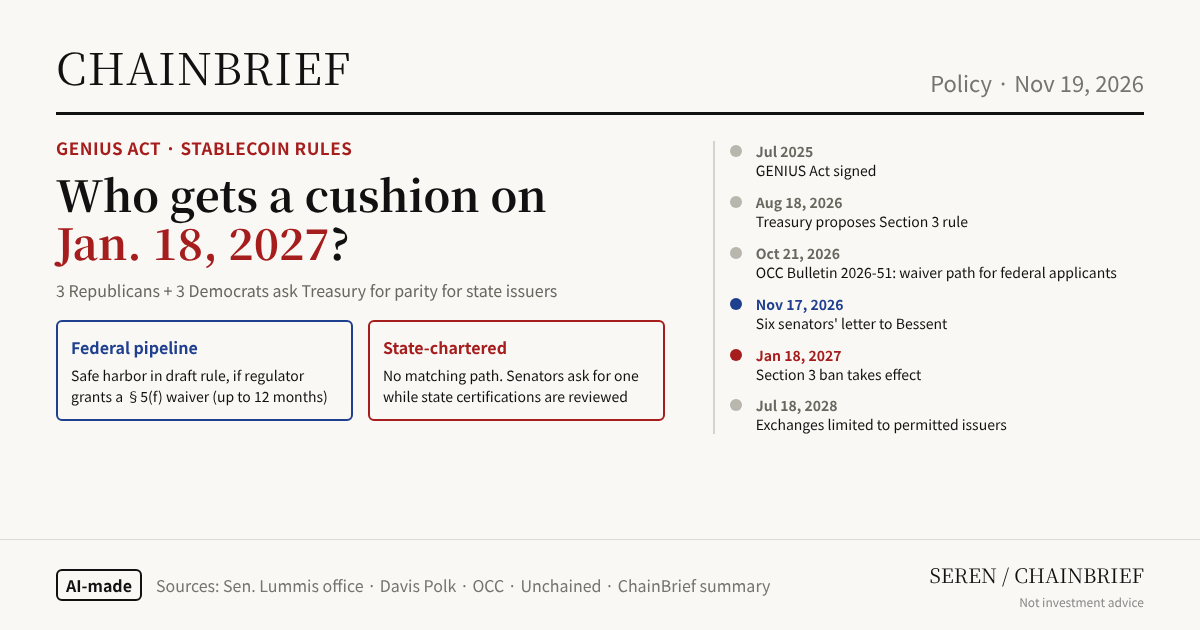
A stablecoin company chartered in Wyoming and one waiting on a federal license could be doing the same business on Jan. 18, 2027. Under the rule Treasury has drafted, only the second one gets a cushion while regulators finish their paperwork. Six U.S. senators want that changed.
Republicans Cynthia Lummis of Wyoming, Kevin Cramer of North Dakota and Pete Ricketts of Nebraska joined Democrats Kirsten Gillibrand of New York, Angela Alsobrooks of Maryland and Mark Warner of Virginia in a letter to Treasury Secretary Scott Bessent. The letter is dated Nov. 17, and Lummis's office released it on Nov. 18. It asks Treasury to give state-supervised issuers the same temporary protection the department has already sketched out for issuers in the federal pipeline.
The gap in the draft rule
The GENIUS Act, signed in July 2025, is the federal law for payment stablecoins, the dollar-pegged tokens used to move money on blockchains. Its Section 3 bans anyone from issuing a payment stablecoin in the United States unless they are a "permitted" issuer. That ban switches on with the rest of the law on Jan. 18, 2027.
Treasury published its proposed rule for Section 3 in the Federal Register on Aug. 18, and the comment window closed in October. According to a Nov. 2 summary by law firm Davis Polk, the draft offers a safe harbor from the ban to two kinds of firms: subsidiaries of insured banks and federal qualified issuers that have an application pending on the effective date. Even they only qualify if their federal regulator grants a waiver under Section 5(f) of the law, which can last up to 12 months.
The Office of the Comptroller of the Currency has already set out how that will work for its side. In Bulletin 2026-51, dated Oct. 21, the OCC said any issuer with a substantially complete application on file by Jan. 18, 2027, may ask for a waiver. It said it generally expects to grant them to issuers already operating in the United States and plans to decide most requests by that date. Firms that are not yet operating in the country should not expect one.
State issuers have no matching path in the draft. That is the hole the senators want filled.
How the state route is meant to work
The law gives smaller issuers a choice. A company with $10 billion or less in stablecoins outstanding can stay under a state regulator instead of a federal one, as long as that state's rules are "substantially similar" to the federal framework. States have to certify that their regimes meet the bar, and a federal Stablecoin Certification Review Committee checks those certifications.
The timing is the problem. In the senators' account, the committee will be reviewing state certifications during 2027, after the Section 3 ban has already taken effect. A state-chartered issuer could find itself legally exposed for months simply because Washington had not finished reading its state's homework.
The letter asks Treasury to grant a safe harbor from Section 3 to issuers in states that have certified their regimes while that review is underway. Reporting by Unchained, which quoted the letter, says the request covers states that will have a framework in place before Jan. 18, 2028. The senators also argue that Congress expected Wyoming, New York and Nebraska to qualify from day one, through a fast-track certification process written into Section 4(c)(7) of the law.
"Parity with the OCC is essential to preserve the dual banking system," the release from Lummis's office said. The dual banking system is the century-old American arrangement in which a bank can choose a state or a national charter.
Why these six
The names on the letter track the states with the most at stake. Wyoming created its special purpose depository institution charter for crypto firms in 2019, and in August 2025 the state launched its own state-issued stable token, FRNT. New York's Department of Financial Services has supervised dollar-backed stablecoins for years under its trust charters. Nebraska passed its own digital asset depository law and is one of the three states the release names.
It is also not the first time this group has pressed the point. Lummis, Cramer, Alsobrooks and Gillibrand wrote to Bessent in June asking Treasury to preserve state authority and set out a timeline for state issuers, The Block reported. The new letter adds Ricketts and Warner and is narrower: one safe harbor, one deadline.
The release goes further on Wyoming. It says issuers chartered there are not required to move to federal supervision when they cross the $10 billion line, a reading tied to Wyoming's charter model rather than to the general rule for other states.
The case for Treasury's narrower version
The draft rule mirrors how the statute is built. Section 5(f) waivers are a federal tool that a federal regulator grants case by case, after looking at a specific applicant. A blanket safe harbor for every issuer in a certified state would cover companies no federal official has examined, in states whose rules the review committee has not yet signed off on.
Banking groups have spent much of the year asking for more time on GENIUS rulemakings in general. The American Bankers Association and state bankers' associations twice sought longer comment periods on Treasury's separate proposal for judging whether state regimes are substantially similar. Their concern was getting the federal and state standards right before the deadlines hit, not giving any one charter an advantage.
Treasury has not commented on the letter in the reports ChainBrief reviewed. The proposed Section 3 rule is still a proposal, so the department can change it before it is finalized.
What changes on Jan. 18
For issuers already in the federal queue, the OCC has signaled that existing operators with complete applications should get waivers, so the effective date need not interrupt their business.
The pressure falls on smaller and state-chartered players. Without a safe harbor, a Wyoming- or New York-supervised issuer would need its state certified and accepted in time, or would have to argue its way into a federal waiver it was never designed to need.
There is a second deadline behind the first. Davis Polk notes that starting July 18, 2028, digital asset service providers such as exchanges may not offer or sell a payment stablecoin to people in the United States unless it comes from a permitted issuer or a comparably regulated foreign one. A state-chartered issuer whose status is still unresolved by then would face a much smaller market.
The effective date is less than two months away, and Treasury has not said when it will finalize the Section 3 rule or whether the final version will treat state and federal applicants alike. The OCC has said it will rule on most waiver requests by Jan. 18, 2027, the same day the ban takes effect.
This article is for information only and is not investment advice.
Sources
- Office of Sen. Cynthia Lummis · Lummis, Gillibrand, colleagues urge Treasury to give state stablecoin issuers equal footing
- The Block · Senators: Treasury must ensure 'equal footing' for stablecoin issuers
- Unchained · Senators say Treasury's GENIUS Act rule leaves state stablecoin issuers without cover
- Davis Polk · Treasury proposes rule to implement GENIUS Act's requirements on US issuance, offer and sale
- OCC · Bulletin 2026-51: GENIUS Act waivers and application submission guidance
- Troutman Pepper · ABA and state bankers again seek GENIUS Act comment period extension