
CFTC’s Selig gives Hyperliquid two ways into the US, and no shortcut
The CFTC chair said onchain trading venues can register as exchanges or work through one that already is, but will get no separate rulebook. Backpack has just shown what the first route takes.
In FocusPolicy & Regulation20 flashes · 13 stories
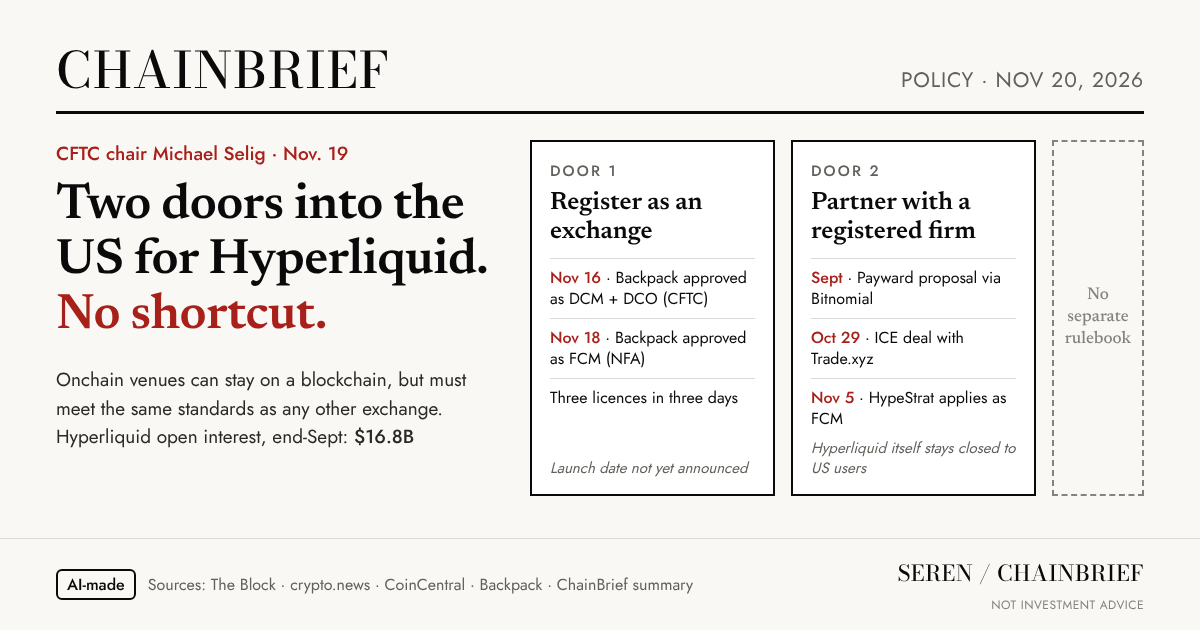
Hyperliquid ended the third quarter holding $16.8 billion in open derivatives positions, more than Bybit, Kraken or OKX, and it did that without a single American customer. On Thursday the man who decides whether that changes laid out the terms. Michael Selig, chairman of the Commodity Futures Trading Commission, said a decentralized venue can come into the United States in one of two ways, and neither involves a rulebook written just for it.
Selig was speaking in Washington on Nov. 19 at the Capitol Crypto Forum, an event run by The Hill and The Block. Asked how a platform like Hyperliquid could enter the U.S. market, he described two routes. The venue can register as an exchange itself. Or it can partner with a firm that is already registered. Either way, he said, it can keep running on a blockchain, but it has to meet the same standards as any other exchange. Crypto.news and CoinCentral both reported that he ruled out special treatment for onchain venues.
His argument for letting them in at all was practical. "These things are going to happen. It's a question of where they happen," he said, according to crypto.news. Keep perpetual futures out of the country, in other words, and Americans who want them will keep trading them offshore.
Backpack went through the first door this week
The first route is no longer hypothetical. On Monday, Nov. 16, the CFTC approved Backpack, a crypto exchange, as a designated contract market and a derivatives clearing organization. In plain terms, that is a licence to run the trading venue and a separate licence to stand in the middle of every trade and guarantee it settles. Two days later the National Futures Association, which licenses brokers on the CFTC's behalf, approved Backpack as a futures commission merchant, the broker that signs up customers, holds their money and screens them for money-laundering risk.
That makes three licences in three days. Backpack says it plans to offer leveraged perpetual futures and event contracts around the clock, with U.S. users trading on the same global order book as everyone else and posting either dollars or crypto as collateral. Neither the company nor The Block, which covered both announcements, gave a launch date.
Backpack US is run by Mark Wetjen, a former CFTC commissioner. He told The Block the broker licence completed the picture.
It was not the only approval. tZERO, a trading-technology firm, received its own exchange approval the week before and already held a clearinghouse licence, according to The Block. Selig said the two decisions opened a regulated path for blockchain-based market infrastructure. He also said in a statement that the law sets out principles for exchanges and clearinghouses without dictating the technology underneath. The duties stay the same: keep customer assets separate, watch for manipulation, hold enough capital and manage risk.
The second door is already crowded
The partnership route has several companies standing in it. Payward, Kraken's parent, proposed in September to list Hyperliquid-linked perpetuals through Bitnomial, a regulated exchange and clearinghouse, with NinjaTrader Clearing handling customer accounts. Intercontinental Exchange, owner of the New York Stock Exchange, signed a deal with Trade.xyz on Oct. 29. On Nov. 5, HypeStrat Markets, a unit of the listed company Hyperliquid Strategies, applied to register as a futures commission merchant. Crypto.news and CoinCentral reported all three.
CoinCentral pointed out the catch. None of these arrangements authorizes Hyperliquid itself. They let a regulated American firm offer products tied to Hyperliquid's markets, while the exchange stays closed to U.S. users.
That distinction is what Selig drew on Thursday. A partnership puts a registered intermediary between the customer and the chain. It does not turn the chain into a registered exchange.
How big the thing knocking actually is
The Hyperliquid Research Collective, an independent group that tracks the exchange, put its open interest at a record $16.8 billion at the end of September. That was up nearly 80% from the end of June, The Block reported. Across Hyperliquid and eight large centralized exchanges, its share of open positions rose to 11.7% from 9.6% three months earlier. Put differently, more than one in every nine dollars of open bets in that group of venues sat on a platform U.S. customers cannot use.
The political push behind letting it in is not new. On Aug. 19, President Donald Trump told a press conference that Selig was working to bring Hyperliquid into the United States in a compliant way. The HYPE token jumped about 17% within a day, The Block reported at the time.
Other regulators are moving the other way. Hong Kong's Securities and Futures Commission added Hyperliquid to its list of suspicious trading platforms on Nov. 18, saying it has no licence there.
What Selig is defending at the same time
The forum was not only about crypto venues. Selig also said the agency would work with the Justice Department when states sue platforms that the CFTC already oversees. Derivatives belong with the market regulator, not the states, he argued, while drawing a line between regulated exchanges and casinos, which he said the CFTC has no business supervising. The CFTC and the Justice Department sued Arkansas and Louisiana on Nov. 13 over their actions against prediction markets, according to The Block.
He also defended single-stock perpetuals, the no-expiry contracts tied to company shares that the CFTC cleared earlier this month. Lacking an expiry date does not make them securities swaps, he said. They are structured as futures, with daily funding payments doing the work that variation margin does in an ordinary futures contract. A federal judge in New York said on Nov. 3 that an industry group challenging those contracts was likely to win its case but declined to block them for now.
Selig is doing all of this as the CFTC's only sitting commissioner. Two nominees, Nathan Anonick and Matthew Rowland, appeared before the Senate Agriculture Committee on Nov. 17. Until they are confirmed, every approval above rests on one vote.
Where the debate sits
Supporters of Selig's approach say it is the only consistent one. Treat an onchain venue exactly like a traditional one and nobody can claim the CFTC picked winners by technology. Backpack's three licences in a week show the process can move quickly for a firm willing to take on a U.S. broker, clearinghouse and compliance staff.
The critics' objection is the mirror image. A venue built on a public blockchain with no company in the middle of trades cannot easily put a broker at its front door without stopping being that kind of venue. For Hyperliquid, the first door means becoming something closer to a conventional exchange. The second means letting others sell its markets while it stays outside. Selig, on Thursday, offered nothing in between.
Hyperliquid's policy group has previously asked the CFTC to separate software developers from intermediaries more clearly, CoinCentral noted. The agency's broader crypto framework, an advance notice covering crypto transactions and a new type of crypto market, is still open for comment. That window closes on Dec. 14.
This article is for information only and is not investment advice.
Sources
- The Block · CFTC Chair Selig outlines how Hyperliquid and other onchain venues could enter the US
- crypto.news · CFTC chair outlines two paths for Hyperliquid's US entry but rules out special exemptions
- CoinCentral · CFTC draws the line for Hyperliquid and onchain trading platforms
- The Block · CFTC backs blockchain-based derivatives infrastructure as Backpack, tZERO win approvals
- Backpack · FCM license and NFA membership
- The Block · Hyperliquid leapfrogs Bybit, Kraken and OKX in open interest