
CFTC freezes Kalshi’s bets on Trump’s words and gives it until Dec. 11 to defend them
The CFTC has stayed two Kalshi contracts that paid out on which words President Trump says, and opened a proceeding into whether the exchange falsely certified them. Kalshi must answer by Dec. 11, while the agency keeps suing states to protect the same industry.
DevelopingKalshi vs. Regulators3 flashes · 2 stories
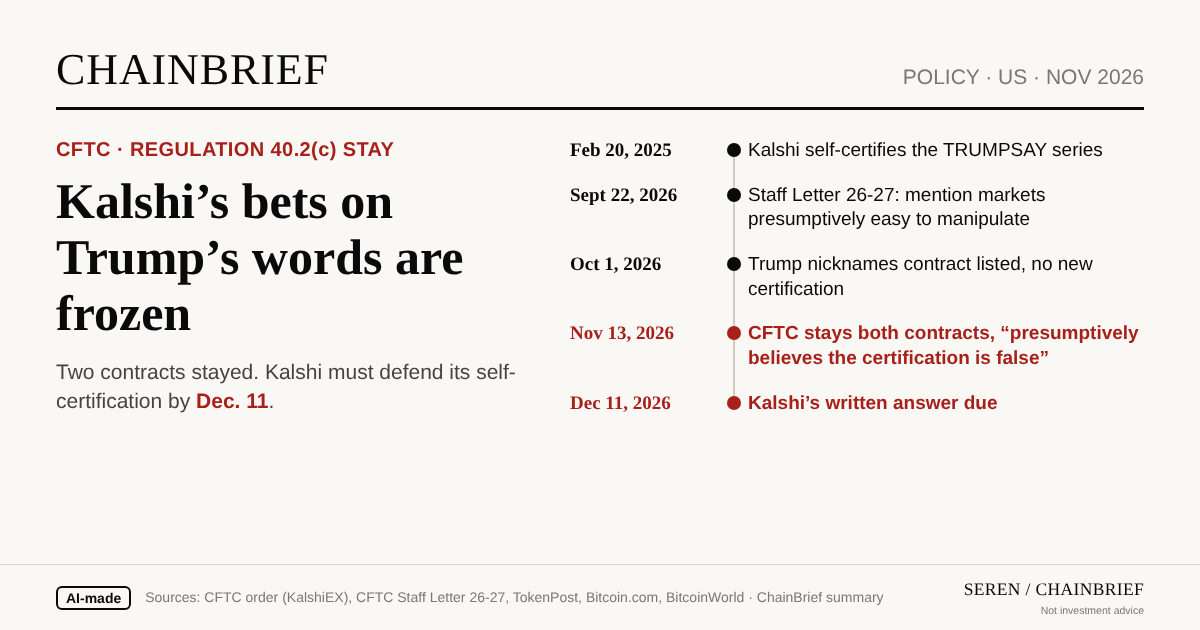
For about a year, anyone with a Kalshi account could put a dollar on whether President Donald Trump would say a particular word before a set date. That market is now frozen, and the exchange has until Dec. 11 to explain to its own regulator why it should ever reopen.
The Commodity Futures Trading Commission issued an order staying two Kalshi listings and opening a proceeding into whether the company's paperwork for them was false. TokenPost, BitcoinWorld and Finance Magnates all date the order to Nov. 13. The document on the CFTC website names the targets: the "TRUMPSAY" series, built on the template "Will <word> be said by Donald Trump after issuance and before <date>?", and a separate contract asking which nicknames Trump will use before 2027. That second contract had been listed since Oct. 1.
The commission went further than a pause. It wrote that it "presumptively believes the certification is false," a phrase that puts the burden on Kalshi. The order also says the commission has made no final decision on whether the contracts break the law.
Kalshi is complying. A company spokesperson, Dani Lever, confirmed that to CNBC, according to Bitcoin.com's account of that report. Chief executive Tarek Mansour told Axios that he disagreed with the decision, arguing that the president's remarks move markets and that forecasting them therefore has real value.
Two contracts, one presumption
Some background on how these products reach the market helps here. U.S. prediction exchanges such as Kalshi are regulated as designated contract markets, the same category as big futures exchanges. Under the CFTC's Regulation 40.2 they can list a new contract by certifying on their own that it complies with the Commodity Exchange Act. They do not need prior approval. One of the act's core principles says an exchange may list only contracts that are not readily susceptible to manipulation.
Self-certification works on trust, and Regulation 40.2(c) gives the commission a way to step in when it believes a certification is false. It can stay the listing while it decides. That is the tool the commission used here.
The order traces the TRUMPSAY series back to a self-certification filed on Feb. 20, 2025. A footnote says the first market in the series opened on Nov. 18, 2025, which means the freeze arrived almost exactly a year into its life. Each contract carries a $1 notional value and trades between 1 and 99 cents, so the price reads as the market's percentage odds.
The timing complaint is specific. According to the order, Kalshi listed the nicknames contract about a week after CFTC staff published new guidance on Sept. 22, and did so without amending its old certification or filing a fresh one. In the commission's reading, Kalshi relied on paperwork written before the rules of the road changed.
How big are these markets? The only figure in circulation is roughly $90 million a month in trading volume. Dealroom attributes it to a person familiar with the matter, and Finance Magnates cites Reuters for the same number via unnamed sources. Neither the CFTC nor Kalshi has confirmed it.
Reports also differ on scope. CNBC, as relayed by Bitcoin.com, described a wider set of paused Trump markets, including bets on which subjects, countries and companies he would mention in November. The CFTC order itself names only the two contracts above. Some mention markets stayed open: a contract on Vice President JD Vance's appearance at the New York Times DealBook Summit was still trading on Tuesday, Bitcoin.com reported.
The teleprompter case behind the rule
The guidance that tripped Kalshi up grew out of a scandal over the summer. Gabriel Perez, a White House teleprompter operator, traded Kalshi mention contracts on Trump's speeches after seeing the text in advance. He was right on 39 of 43 contracts, according to Bitcoin.com and BitcoinWorld.
The CFTC settled with him on Aug. 28. He had to give back $107,539.02, pay a $65,000 penalty and stay out of regulated markets for three years, TokenPost and BitcoinWorld reported. Decrypt rounded the two payments together as $172,000.
Less than a month later, on Sept. 22, the CFTC's Division of Market Oversight published Staff Letter No. 26-27. It covered contracts that settle on whether a named person says certain words, attends an event, or does something like shake a hand or post online. The problem, staff said, is that the outcome depends on one person's behavior, which may not be independent or checkable by anyone outside. Staff described such contracts as presumptively easy to manipulate, while leaving room for an exchange to rebut that with evidence.
The letter was not binding. It represented the views of staff, not the commission itself. But it listed what staff expected to see in any filing: a contract-specific manipulation analysis, restricted lists of insiders who cannot trade, third-party screening, warning pop-ups, position limits and tighter surveillance. Kalshi had already stopped offering mention markets on sports events in August, at the regulator's request, according to Bitcoin.com and Reuters as cited by BitcoinWorld.
In plain terms, the September letter told exchanges that a bet on one person's words needs extra guard rails. The November order says Kalshi kept listing one without showing it had them.
A regulator on both sides
The order lands at an odd moment for the CFTC. Comments close today, Nov. 18, on two rulemakings the agency published in the Federal Register on Oct. 19, according to KPMG and Weiss Ratings. One proposal would write event contracts on sports, politics, culture and weather expressly into the legal definition of a swap. That would put them firmly under federal oversight. An interim final rule, already in force, carves out state-licensed sports betting and casino games.
At the same time, the agency is in court defending the industry against states. The CFTC and the Justice Department sued Arkansas on Nov. 12 to stop it from applying gambling laws to federally regulated prediction markets, Weiss and Bitcoin.com reported. The CFTC sued Louisiana on Nov. 13. Louisiana's Justice Department wrote to a federal court in New Orleans on Nov. 16 asking it to pause that case, according to ChainCatcher.
So the commission is arguing in court that states should leave these markets to Washington, and arguing in its own proceeding that one of the biggest exchanges did not follow Washington's standard. Both positions rest on the same claim, that the CFTC is the referee.
Kalshi also has a second problem with the same regulator. Weiss and Bitcoin.com report that the CFTC is examining how Kalshi notified it about new contracts and has raised the possibility of charges. Kalshi has called it a filing error that it is fixing.
The politics are close to home as well. Donald Trump Jr. ended his paid adviser role at Kalshi after his firm, 1789 Capital, added to its investment in rival Polymarket, Engadget and Bitcoin.com reported.
What Kalshi has to show by Dec. 11
The order asks for a written answer filed with the commission's secretary by Dec. 11. Kalshi has to demonstrate why its certification should not be found false. After that, the commission can ask for more information, hold further proceedings or make a final determination. The stay stays in place the whole time.
The outcome matters beyond one market. If the commission accepts that a mention contract with insider lists and surveillance can be listed, the September letter becomes a working checklist for every exchange that wants to offer one. If it finds the certification false, any exchange that self-certified a mention market before September has reason to recheck its own filings.
Kalshi's answer is due in 23 days. Until the commission rules on it, nobody on a U.S. exchange can bet on Trump's next word through the TRUMPSAY series.
This article is for information only and is not investment advice.
Sources
- CFTC · Order Instituting Proceedings and Staying the Listing of the Contract Under Regulation 40.2(c), KalshiEX LLC
- CFTC · Release 9302-26, CFTC Releases Staff Advisory on Mention Markets
- Engadget · CFTC tells Kalshi to stop letting people bet on Trump's speeches
- Bitcoin.com News · Kalshi axes Trump mention markets after CFTC raises concerns
- TokenPost · CFTC stays Kalshi's Trump mention listings during review
- KPMG · Prediction markets: CFTC proposal, interim final rule on event contracts