
Supreme Court ends Custodia’s six-year fight for a Fed master account
The Supreme Court declined on Monday to hear Custodia Bank’s case, leaving in place a ruling that Reserve Banks may refuse master accounts even to legally eligible banks. Crypto firms now depend on the Fed’s narrower “skinny” account, which is still only a proposal.
In FocusFed & Rates7 flashes · 3 stories
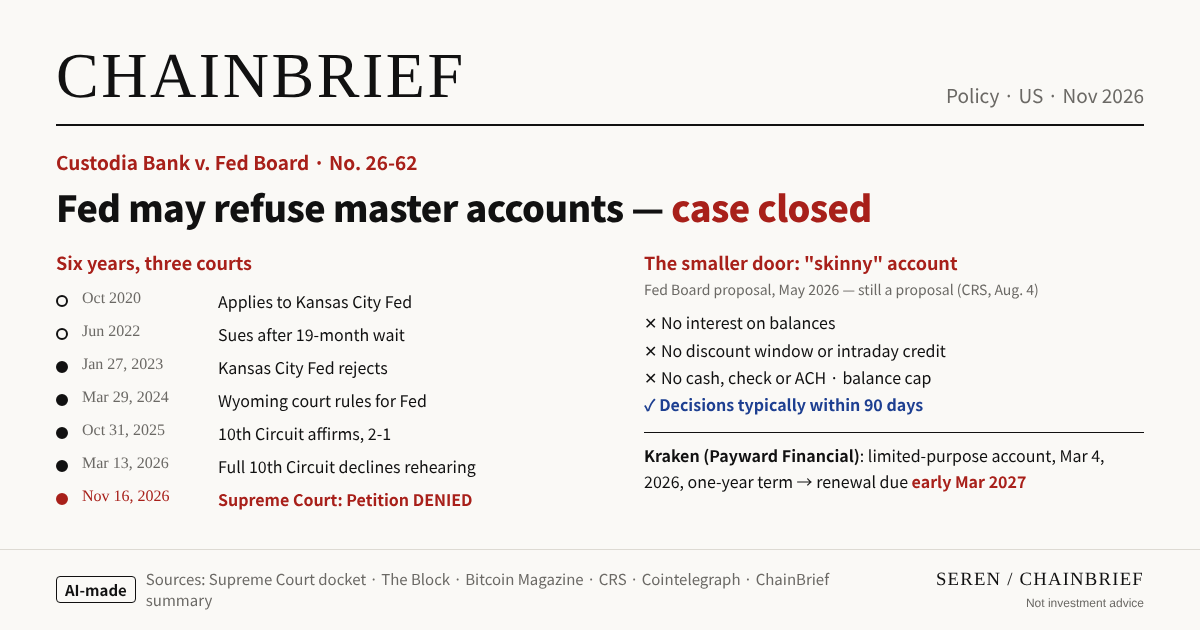
Custodia Bank asked the Federal Reserve Bank of Kansas City for an account in October 2020. On Monday, Nov. 16, 2026, the last route to forcing the Fed to say yes closed with two words on the Supreme Court's docket: "Petition DENIED."
The justices turned away case No. 26-62, Custodia Bank v. Federal Reserve Board of Governors, on the order list that followed their Nov. 13 conference, according to the court's docket and reports by The Block and Bitcoin Magazine. They gave no reasons, and neither outlet reported a dissent from any justice. The denial leaves in place an October 2025 appeals court ruling that the regional Reserve Banks have discretion to refuse a master account, even to a bank that is legally eligible for one.
A master account is the account a bank holds at the Fed itself. It lets the bank move dollars over Fedwire and other Fed payment rails directly, instead of paying a larger correspondent bank to do it. For a small bank built around crypto clients, that intermediary is the weak point. If the correspondent pulls out, the bank cannot move money.
Neither Custodia nor its founder, Caitlin Long, had commented by Monday morning, Bitcoin Magazine reported. The Block said the bank did not immediately respond to a request for comment.
Six years, three courts
Custodia is a Wyoming special purpose depository institution, a state charter created for digital-asset businesses. It cannot lend out customer dollar deposits and must back them fully with liquid reserves. Its supporters argued that a bank that does not lend is about as safe as a bank can be.
The Kansas City Fed did not see it that way. Bitcoin Magazine's timeline runs like this. The bank applied in October 2020, and three months later Kansas City Fed staff told it that it was legally eligible. Custodia sued in June 2022 over what had by then become a 19-month wait. On Jan. 27, 2023, the Kansas City Fed rejected the application, describing a business model that was new and narrowly focused on crypto assets. The Fed Board turned down Custodia's separate application to become a Fed member bank the same day.
Judge Scott Skavdahl of the U.S. District Court in Wyoming ruled for the Fed on March 29, 2024. The U.S. Court of Appeals for the Tenth Circuit affirmed on Oct. 31, 2025, by a 2-1 vote. Writing for the majority, Judge David Ebel, joined by Judge Veronica Rossman, read the Federal Reserve Act's language that a Reserve Bank "may" receive deposits as a grant of discretion. He also read the Monetary Control Act of 1980, which says Fed services "shall be available" to nonmember banks, as a rule about pricing those services rather than a right to an account.
Judge Timothy Tymkovich dissented. In his view, he wrote, "shall means shall." The full Tenth Circuit declined to rehear the case on March 13, 2026, with Tymkovich and Judges Harris Hartz and Allison Eid voting to take it up.
The question the justices left open
Custodia's petition, filed July 10 by Kannon Shanmugam of Davis Polk, asked the court to decide whether the 1980 law lets the presidents of regional Reserve Banks deny master accounts to nonmember banks that qualify under the law. It drew friend-of-the-court briefs from the Blockchain Association, The Digital Chamber, and Sen. Cynthia Lummis with former Sen. Pat Toomey, the docket shows.
The other side was the government itself. The Fed Board, represented by the Solicitor General's office, and the Kansas City Fed, represented by King & Spalding, both filed briefs on Oct. 13 urging the justices not to take the case.
Turning down a petition does not mean the Supreme Court agrees with the lower court. It means the court chose not to answer the question this time. In practice the effect is the same for now. In the six states the Tenth Circuit covers, including Wyoming, the Fed's discretion is now settled law.
A smaller door opened instead
The irony is that while Custodia's case moved toward the Supreme Court, the Fed began letting crypto firms in through a narrower entrance.
On March 4, 2026, the Kansas City Fed approved a "limited-purpose account" for Payward Financial, the Wyoming banking arm of Kraken, Cointelegraph reported. The account gives direct Fedwire access but pays no interest on reserves, and it runs for an initial term of one year with restrictions fitted to the firm's business. That made Kraken the first crypto company with an account at the Fed.
Not everyone welcomed it. Rep. Maxine Waters, the top Democrat on the House Financial Services Committee, wrote to Kansas City Fed President Jeff Schmid later that month. She noted that neither federal law nor the Fed's account guidelines mention a "limited purpose account," and asked what services and limits came with it, The Block reported. The Bank Policy Institute, which represents large banks, objected that the approval came before the Fed had finished a public framework for such accounts.
That framework has been in the works since Fed Governor Christopher Waller floated a "skinny" master account in October 2025. In May 2026 the Fed Board proposed one formally, according to a Congressional Research Service note dated Aug. 4. Under the proposal the Fed would pay no interest on balances and would offer no discount-window loans or intraday credit to cover overdrafts. It would also exclude cash, check and ACH services and cap the balance an account could hold. In return, approvals would typically come within 90 days. Governor Michael Barr dissented, arguing the proposal lacked enough anti-money-laundering safeguards. CRS described it as still a proposal in August.
What a skinny account cannot do
For Custodia, the difference between the two kinds of account mattered enough to say so in its Supreme Court filings. The bank argued that a limited account would not be enough, in part because it could not earn interest on the balances it holds overnight, The Block reported, citing Bloomberg.
The point is less technical than it sounds. A bank that must keep every customer dollar in reserve earns its living on the yield of those reserves. Interest on reserve balances at the Fed is the simplest such yield. Take it away and the business model gets thinner.
The numbers show how rare full access is for newcomers. Between December 2022 and May 2026, three applicants in the Fed's highest-scrutiny group, Tier 3, received master accounts, and none in Tier 2 did, according to the CRS note. Custodia had been placed in Tier 3 when the Fed published its account guidelines in 2022.
So the legal map after Monday is simple. A Reserve Bank can say no, and courts will not overrule it on the grounds Custodia pressed. A crypto bank that wants a direct line to the Fed now has two options. It can apply and accept whatever terms a regional Reserve Bank offers, or wait for the Fed to finish its skinny-account rule.
The next date on that path belongs to Kraken. If its account runs a full year from the March 4 approval, the Kansas City Fed has to decide on a renewal in early March 2027.
This article is for information only and is not investment advice.
Sources
- Supreme Court of the United States · Docket No. 26-62, Custodia Bank v. Federal Reserve Board of Governors
- The Block · Supreme Court rejects Custodia Bank's bid for Fed master account
- Bitcoin Magazine · Supreme Court ends Custodia's fight for a Fed account
- Congressional Research Service · Federal Reserve: "Skinny" Master Account Proposal
- Cointelegraph · Kraken secures Fed master account
- The Block · Rep. Waters presses Kansas City Fed on Kraken master account