
CFTC’s state lawsuits reach 12 as its prediction market rule closes for comment Wednesday
Arkansas and Louisiana became the 11th and 12th states the CFTC has taken to court over sports and election contracts in the space of two days. The federal rule the agency is leaning on is still a proposal, and public comments close on Nov. 18.
In FocusPolicy & Regulation20 flashes · 13 stories
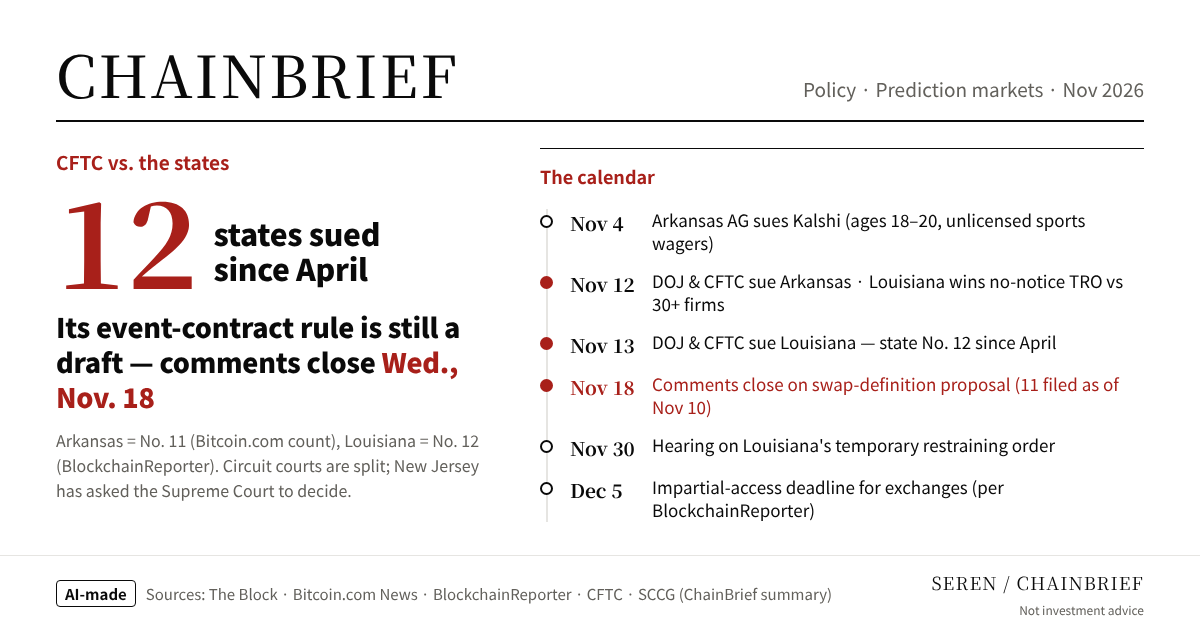
In Arkansas you have to be 21 to place a legal sports bet. Kalshi, the state says, has been letting customers aged 18 to 20 trade contracts on game results anyway, and on Nov. 4 Attorney General Tim Griffin sued the company over it. Eight days later the federal government sued Arkansas.
The Justice Department and the Commodity Futures Trading Commission filed a 34-page complaint in the U.S. District Court for the Eastern District of Arkansas on Thursday, Nov. 12, according to The Block and Bitcoin.com News. They want preliminary and permanent injunctions that would stop the state from investigating or enforcing its gambling laws against exchanges the CFTC regulates. The next day the same two agencies sued Louisiana in federal court in New Orleans.
By Bitcoin.com's count Arkansas is the 11th state the CFTC has taken to court over prediction markets since April. Louisiana makes 12, as BlockchainReporter tallied it. That is roughly one state in four.
What Arkansas wants from Kalshi
Griffin's case is broader than the age issue. His office accuses Kalshi of taking unlicensed sports wagers and of deceptive practices, and it asks for restitution, unpaid taxes and penalties of up to $10,000 per violation, plus an injunction, Bitcoin.com reported. Federal lawyers argue that with per-violation penalties the total could reach hundreds of millions of dollars.
The federal answer rests on one claim. Under the Commodity Exchange Act, the CFTC says it has exclusive jurisdiction over swaps traded on the exchanges it registers, and in its view a contract on a football score listed on Kalshi is one of those swaps. If that holds, state gambling law cannot reach it. Arkansas, in the complaint's framing, is intruding on a federal system.
Louisiana moved faster, and harder
Louisiana did not wait for a trial. On Nov. 12 the attorney general's office, led by Liz Murrill, filed a petition in the 21st Judicial District Court in Tangipahoa Parish against Kalshi and more than 30 other companies, including Polymarket, Coinbase and Robinhood, according to BlockchainReporter and The Block. A judge granted a temporary restraining order that evening without notice to the companies or a hearing. The order bars them from offering event contracts on sports, elections and award shows to people in Louisiana without a state license and permit.
The stakes in Louisiana are criminal as well as civil. A state law that took effect Aug. 1, Act No. 182, sets fines of up to $100,000 and prison terms of up to five years for gambling by computer, BlockchainReporter reported.
The CFTC and DOJ filed their suit in the Eastern District of Louisiana on Nov. 13, naming the state, Murrill, the Louisiana Gaming Control Board and state police gaming officials. CFTC Chairman Michael Selig called the state's move "naked lawfare and a cynical political stunt." Murrill answered on X by calling Selig an "obsequious standard bearer" for Kalshi, as The Block reported on Saturday. A hearing on the state order is set for Nov. 30.
A rule that is still a draft
Selig's lawyers are arguing that the law already puts these contracts under federal control. At the same time, his agency is writing a rule to make that explicit.
On Oct. 9 the CFTC published two documents, according to a Skadden client note. The first is a proposed rule that would add event contracts on sports, politics, culture and weather to the agency's definition of a swap. The second is an interim final rule, already in force, that carves out casino-style gambling. To fall outside the CFTC's reach under that test, a product has to be offered by a business licensed by a state or tribe and must not trade on a CFTC-registered exchange or other multilateral market. A sportsbook app licensed in New Jersey stays with New Jersey. A sports contract on Kalshi does not.
Comments on both documents close on Wednesday, Nov. 18. As of Nov. 10 the proposal had drawn 11 public comments, according to gaming consultancy SCCG. Among them were a company with pending exchange and clearinghouse applications and one letter urging the CFTC to withdraw the rule, citing the ban on games of chance in Utah's constitution. For a rule that would decide who regulates a market now fought over in a dozen courtrooms, that is a short stack of mail.
The agency has a second deadline running. On Nov. 5 it issued an interpretation of the impartial access rule for designated contract markets, the CFTC's term for regulated exchanges. Exchanges have 30 days to stop blocking customers by state or explain to the agency why they cannot, the CFTC said in release 9323-26. Counting from the release date, BlockchainReporter put that deadline at Dec. 5. Some venues have shut out users in particular states to limit legal risk; Robinhood and Polymarket US, for example, agreed in October to stop new sports contracts in Ohio and Michigan respectively. The CFTC now says such restrictions conflict with the law it enforces.
The states have won some rounds
The federal argument has not carried every court. The Third Circuit sided with Kalshi against New Jersey in April. A Ninth Circuit panel then ruled that Nevada may enforce its gambling laws against the company, and the Sixth Circuit ruled for Ohio and Tennessee in September. That split is why New Jersey filed a petition on Sept. 2 asking the Supreme Court to decide whether sports event contracts are federal swaps or state-regulated bets, Front Office Sports reported. The justices have not said whether they will take it.
The states' case is simple to state. Gambling licensing, age limits and gaming taxes have been state business for decades, and Arkansas and Louisiana see a sports contract sold to a 19-year-old as a bet with a different label. The CFTC's case is that Congress put derivatives exchanges under one federal regulator so that a contract cannot be legal in one state and a crime across the border. Both readings have support on the bench.
None of this changes what is legal in Arkansas or Louisiana this week. Kalshi still faces Griffin's suit, the Louisiana order is still in effect, and the federal complaints are asking for injunctions that no judge has yet granted.
The first date on the calendar is Wednesday, when the comment window on the swap definition closes and the CFTC can start turning its proposal into a final rule.
This article is for information only and is not investment advice.
Sources
- The Block · DOJ, CFTC sue Arkansas to block state enforcement action against Kalshi
- Bitcoin.com News · DOJ, CFTC Sue Arkansas to Block Kalshi Crackdown
- Cryptonews (BlockchainReporter) · Louisiana won a no-notice order against 32 prediction-market firms
- CFTC · Release 9323-26, Impartial Access Requirements Interpretation
- Skadden · CFTC Moves to Draw the Line Between Event Contracts and Casino-Style Gambling
- SCCG · CFTC sports event contracts rule attracts only 11 comments