
Stablecoins are shrinking at a 2022 pace, and the Fed meets again on Dec. 9
Three data firms count the drop differently, but all of them show dollar tokens leaving crypto at the fastest rate in more than four years. With traders pricing a December rate hike, the question is whether the cash has anywhere better to go.
In FocusStablecoins15 flashes · 3 stories
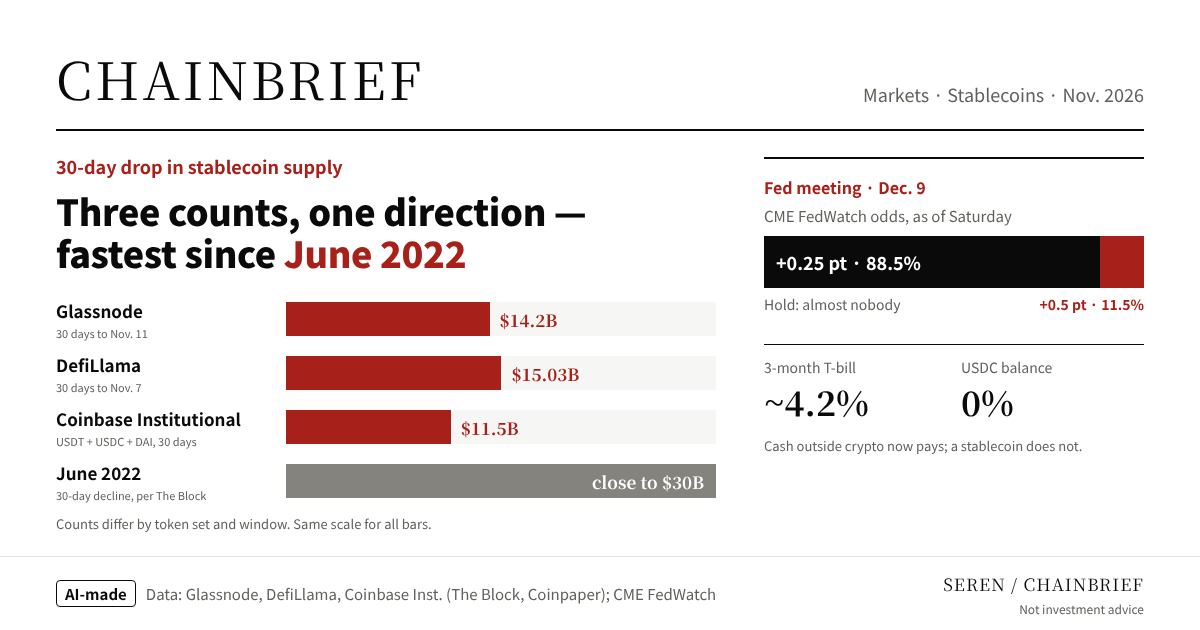
Nearly one dollar in every twenty that sat in stablecoins a month ago is gone. Glassnode put the 30-day decline at $14.2 billion in a report published Wednesday, the fastest contraction since June 2022, according to The Block and TokenPost. On Sunday bitcoin slipped to about $62,100, its lowest since mid-July, and the money that usually buys those dips is the money that has been leaving.
Stablecoins are tokens pegged to the dollar, mostly Tether's USDT and Circle's USDC. Traders park cash in them between bets, so their total supply works as a rough gauge of how much buying power is waiting inside crypto. When holders redeem them for real dollars, that buying power leaves the market entirely.
Three counts, one direction
The data firms do not agree on the exact size of the drop, and the differences come from what each one counts and over which window.
Glassnode's $14.2 billion covers 30 days to Nov. 11. DefiLlama's daily series, compiled by Blockchain Reporter, showed total supply down $15.03 billion over the 30 days to Nov. 7, to about $292 billion. A Coinbase Institutional tally of USDT, USDC and DAI, cited by Coinpaper, put the 30-day fall at $11.5 billion. The Block's own dashboard, which uses a narrower set of tokens, had total supply just under $280 billion.
The two biggest tokens carry most of the weight. CoinDesk reported that USDT and USDC together were worth $244 billion this weekend, the lowest since September 2025, after peaking near $270 billion in early May. CryptoQuant found USDT's market value fell $6.6 billion in the 60 days to Nov. 7, more than twice the $3.2 billion it lost over a similar stretch after FTX collapsed in late 2022, The Block reported.
The week to Nov. 7 was the worst of the year by DefiLlama's numbers, at $6.66 billion. USDT accounted for about $3.1 billion of that and USDC for about $1.3 billion.
For scale, the 2022 crash was larger. The 30-day decline came close to $30 billion in June of that year, The Block noted, roughly double the current pace. Bitcoin's bear-market low of $15,500 arrived about five months later.
A rate hike in the price
What changed in the past week is the cost of money outside crypto.
The Federal Reserve raised its benchmark rate by a quarter point on Sept. 16, to a range of 3.75% to 4%, its first increase in more than three years, Reuters and Al Jazeera reported. Sixteen of 18 officials then projected at least one more hike before the end of 2026.
October's inflation report pushed that projection toward a certainty. Consumer prices rose 0.4% for the month against forecasts of 0.3%, and core prices, which strip out food and energy, rose 0.3% against 0.2%, according to Cointelegraph and crypto.news. Fed Governor Christopher Waller said in London that another core reading that hot could justify a half-point move in December.
By Saturday, CME's FedWatch tool showed 88.5% odds of a quarter-point hike at the Dec. 9 meeting and 11.5% for a half point, as reported by CryptoTicker. Almost nobody is betting on a hold.
Higher rates matter to stablecoin holders in a plain way. A three-month Treasury bill was yielding about 4.2% last week, according to Cointelegraph. A USDC balance pays nothing on its own. Adam Haeems of Tesseract Group told Cointelegraph that rising borrowing costs squeeze carry trades, the strategy of borrowing cheaply to earn a higher yield elsewhere. Lending rates for USDC on Aave's main market swung between about 3.2% and 7% over two weeks, the outlet reported.
Some of the outflow may not be leaving crypto so much as changing form. Startup Fortune pointed to the GENIUS Act, the U.S. stablecoin law that bars issuers from paying interest, as one reason cash is moving into tokenized Treasury funds instead. That argument comes from the outlet's own analysis, and no data firm has measured how much of the decline it explains.
The other hands selling
Stablecoins are only one exit. U.S. spot bitcoin funds lost about $1.07 billion over the five trading days to Nov. 13, with BlackRock's IBIT accounting for roughly $908 million of it, according to Farside data cited by CryptoTicker and The Crypto Desk. Counting from Nov. 5, the outflow streak reached seven sessions and about $1.91 billion, crypto.news reported.
Glassnode also flagged that the Coinbase premium, the gap between bitcoin's price on Coinbase and on offshore exchanges, has been negative on a 30-day average since the September high. A discount on Coinbase usually means U.S. buyers are lighter than sellers elsewhere. TokenPost said the discount is the deepest since February.
Leverage made the weekend worse. CoinGlass counted roughly $2 billion in liquidations in the 24 hours to Sunday morning in Asia, and in one hour alone about $691 million of positions closed, almost all of them bets on higher prices.
Where analysts disagree
The data firms read the same numbers differently on timing.
Glassnode treats the stablecoin count as the signal to wait for. A return to supply growth, it wrote, would be the "first sign that new money is coming in." Its report added that in earlier sell-offs, ETF inflows came back only after bitcoin had already found its low.
CryptoQuant takes the opposite view of the sequence. Its analysts argued a local bottom in bitcoin could form before USDT supply turns positive, The Block reported, meaning the price can stop falling while the cash pile is still shrinking.
Both views can hold at once. A smaller stablecoin float means fewer dollars ready to buy, but it also means fewer leveraged traders left to force-sell, and this weekend's liquidations closed out billions of dollars of them.
Neither camp is making a call on how far prices go from here, and the numbers themselves have limits. A token redeemed for cash shows up as a decline whether its owner is fleeing crypto or simply moving money back to a bank account.
What comes next
U.S. ETF flow data resumes on Monday, Nov. 16, after the weekend gap. MSCI removes Strategy from its global standard indexes at the close on Nov. 30. The Fed announces its decision on Dec. 9.
If the stablecoin count stops falling before then, it would be the first data point Glassnode has said to watch for.
This article is for information only and is not investment advice.
Sources
- The Block · Stablecoin supply drops $14.2 billion in largest contraction since 2022 bear market
- TokenPost · Crypto market loses liquidity as stablecoin supply shrinks by $14.2 billion
- CoinDesk · XRP crashes to its lowest since November 2024 as money leaves crypto
- Cointelegraph via TradingView · Hot US inflation raises odds of half-point Fed hike in December
- Business Standard (Reuters) · US Federal Reserve raises interest rate by 25 bps to 3.75-4% range
- CryptoTicker · Fed hike bets and $1.07 billion in ETF outflows