
CFTC chief says exchanges want his opt-in crypto license. The paperwork is due Dec. 14
Michael Selig told CNBC that crypto venues are lining up for a federal path his agency built after the CLARITY Act stalled. No firm has been named, and the comment window on the framework closes in a month.
In FocusPolicy & Regulation20 flashes · 13 stories
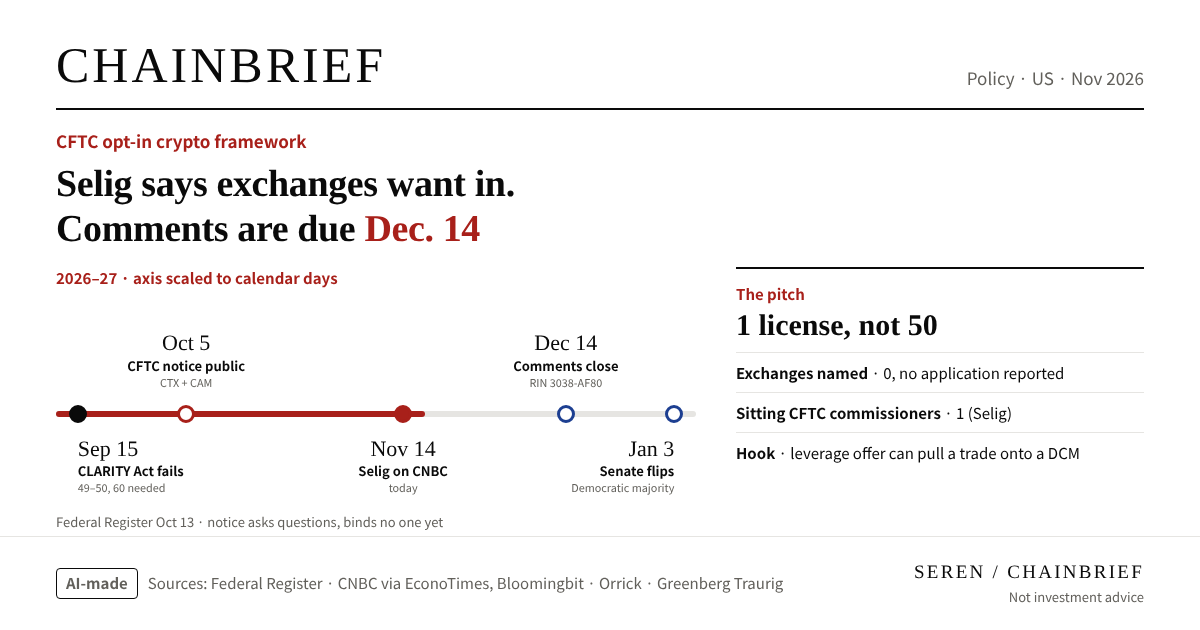
A crypto exchange that wants to serve customers in every U.S. state today usually collects licenses one state at a time, from New York's BitLicense down to the money-transmitter permits most states require. Michael Selig, chairman of the Commodity Futures Trading Commission, is pitching a shortcut: one federal registration, with his agency as the only market regulator.
In a CNBC interview published Friday, Selig said crypto firms are showing interest in that route now that a market structure law looks out of reach. Two groups stood out in his account, according to summaries by EconoTimes and Bloomingbit. One is derivatives venues already registered with the CFTC, some of them listing perpetual futures, that want to add spot trading. The other is newer entrants that would rather hold one license than deal with 50 state regimes.
"Signing up with 50 different state regimes is tough," he said, as quoted by EconoTimes.
What he did not do was name anyone. EconoTimes noted that no firm was identified and no application was reported, and a Startup Fortune analysis said no company has formally committed. For now the claim is the regulator's own read of the room.
A rule written for a bill that never passed
The framework Selig is selling exists because Congress did not finish its own. The CLARITY Act, which would have handed the CFTC the spot market for tokens that are not securities, fell short in the Senate on Sept. 15, when a procedural motion got 49 votes against 50, well under the 60 it needed. Two days later the agency sent its own plan to the White House for review.
That plan went public on Oct. 5 as an advance notice of proposed rulemaking, an early-stage document that asks questions instead of imposing rules. It has two parts. Regulation Crypto Asset Transactions (CTX) explains how the agency reads existing law. Regulation Crypto Asset Markets (CAM) describes a new kind of venue to trade on. The notice ran in the Federal Register on Oct. 13, and comments close on Dec. 14, according to FinanceFeeds, Orrick and Greenberg Traurig.
The legal hook is old. Section 2(c)(2)(D) of the Commodity Exchange Act, added after the 2008 crisis, says retail commodity deals offered with leverage, margin or financing must be done on, or under the rules of, a designated contract market (DCM), the CFTC's term for a regulated exchange like CME. The main way out is actual delivery: if the customer really gets the asset within 28 days, the requirement does not apply.
The CFTC's preliminary reading stretches that further than many exchanges might expect. Orrick and Greenberg Traurig both describe the agency's view that an offer of leverage can be enough to pull a trade in, even when the customer pays in full. A coin that sits only as a balance on the exchange's internal ledger would not count as delivered. Greenberg Traurig said control of private keys may be one test of delivery, and Fenwick's analysis added that coins held in an exchange's cold storage would not, on their own, show that the customer controls them.
A crypto asset market under CAM would be a new subcategory of DCM held to the same 23 core principles that govern futures exchanges, tailored for tokens, according to Steptoe. Trades would go through a futures commission merchant (FCM), a regulated broker, and be cleared by a clearinghouse. Existing DCMs could offer the products under their current registrations, which is the opening Selig's perpetual-futures venues are looking at.
Optional, or optional for now
Selig has framed the whole thing as a choice. In an op-ed quoted by Greenberg Traurig, he wrote that the plan would not require crypto assets to trade on CFTC-registered platforms. A platform that sells only spot coins, with no leverage offer of any kind, could keep its state licenses and stay under the CFTC's general anti-fraud and anti-manipulation powers.
The word "optional" carries some weight here. If an offer of margin on one product can bring an account under the rule, an exchange that runs leverage and spot side by side has less room to stay out than the label suggests. Startup Fortune made a similar point, arguing that the "option" framing is weaker than it sounds.
Other open questions sit in the law firm notes. Steptoe reported the agency's preliminary argument that Congress meant federal rules for these transactions to displace differing state requirements, which is a fight states have shown they will join. Fenwick listed two unresolved items: how much protection from state law a registered venue would actually get, and how customer assets would be treated if a platform went bankrupt.
There is also the durability problem. A rule written by an agency can be rewritten by the next one, and it can be challenged in court in ways a statute cannot. Startup Fortune noted that, without the CLARITY Act, token issuers and decentralized finance builders still have no statutory safe harbor. A CFTC license would not fix that.
One commissioner, and states pushing back
Selig is also the CFTC's only sitting commissioner. The White House sent the Senate two nominees for the commission on Thursday, but the chamber that would confirm them changes hands on Jan. 3, when Democrats take the majority they won in the Nov. 3 midterms.
According to Bloomingbit's summary, Selig said Congress would carry out whatever oversight it considers necessary and urged both parties to protect developers acting in good faith while still going after fraud.
The interview also touched the agency's other running battle with the states, over prediction markets. Louisiana sued ten platforms this week, and a growing list of states treat sports and election contracts as gambling. Selig said he was prepared to take the dispute over the CFTC's exclusive jurisdiction to the Supreme Court if it came to that, according to summaries cited by Startup Fortune and RG.
The two fights rest on the same claim: that federal commodity law sets the rules and the states have to step back. Exchanges weighing a CFTC registration are betting that the claim holds up in court and survives a change of leadership at the agency.
What happens on Dec. 14
Nothing in the notice binds anyone yet. Once comments close, the CFTC would still need to issue an actual proposed rule, take another round of comments, and vote on a final version, which today would mean a vote of one.
The comment docket, under regulatory identifier RIN 3038-AF80, will be the first public record of who is serious. If the exchanges Selig described are real, their names should start showing up there before Dec. 14.
This article is for information only and is not investment advice.
Sources
- Federal Register · Regulation Crypto Asset Transactions and Regulation Crypto Asset Markets (ANPRM)
- EconoTimes · CFTC Chair Says Major Derivatives Exchanges May Add Spot Crypto Trading
- Bloomingbit · CFTC official says crypto exchanges show growing interest in federal regulation
- Orrick · CFTC seeks comment on framework to bring leveraged retail crypto transactions onto regulated exchanges
- Greenberg Traurig · CFTC seeks comments on proposed framework for retail crypto asset trading and markets
- Startup Fortune · CFTC Chair Selig says crypto firms are signing up for his agency's rules as Congress stalls