
Four SEC and CFTC nominees arrive as the Senate that must confirm them runs out of time
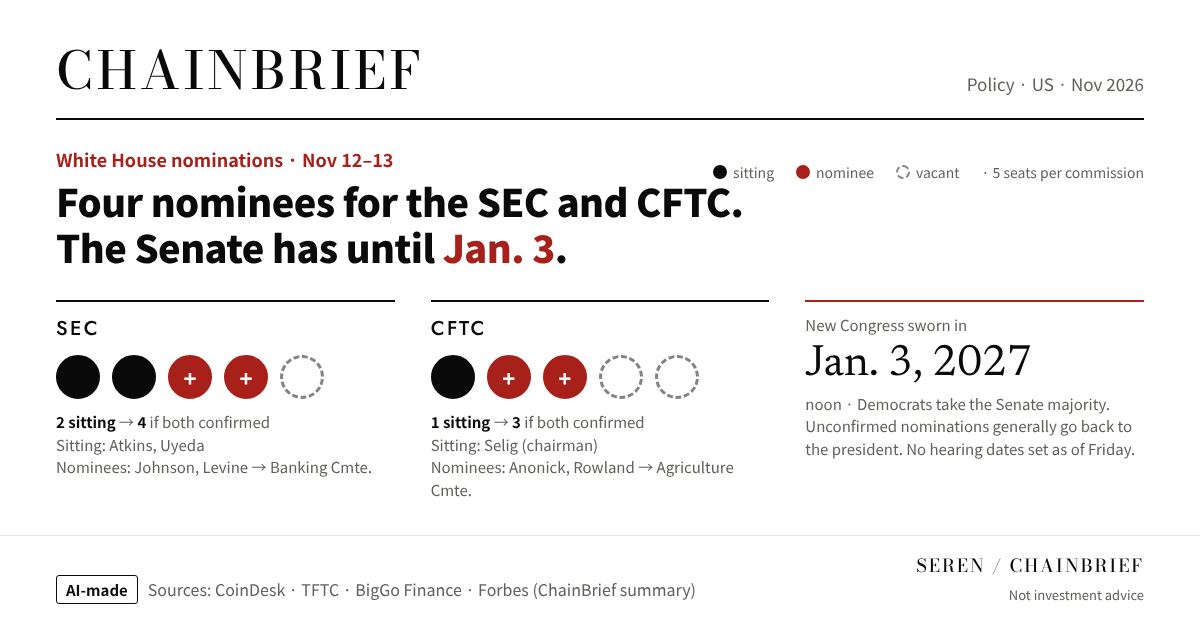
The White House has named two SEC and two CFTC commissioners, its first picks for either agency in about a year and its first Democrats for them. The CFTC has been run by a single commissioner for months. The Senate that would confirm the four hands over to a Democratic majority on Jan. 3.
In FocusPolicy & Regulation20 flashes · 13 stories
For most of this year, every rule, settlement and staff letter at the Commodity Futures Trading Commission has carried the approval of exactly one person. Chairman Mike Selig is the only commissioner on a panel built for five. On Thursday, the White House sent the Senate two names that would end that.
It sent two more for the Securities and Exchange Commission, where Chairman Paul Atkins and Commissioner Mark Uyeda have been the only voting members since Hester Peirce left in early October. Taken together, the four are the first nominations to either market regulator in about a year, CoinDesk reported, and the first Democrats President Donald Trump has put forward for either agency in his second term.
Who is on the list
Two of the four go to the SEC. Kristin Johnson, a Democrat, served as a CFTC commissioner after being appointed under President Joe Biden and left that agency last year. She would take the seat Caroline Crenshaw held until her term ran out, with a term ending June 5, 2029. Steven Levine, an attorney who has worked as general counsel at the White House Council of Economic Advisers and earlier as counsel at the SEC, would take Peirce's seat through June 5, 2030. TFTC and BigGo Finance both list him as a Republican, citing the nomination notices. CoinDesk, working from his LinkedIn profile, said he appears to be one.
The two CFTC picks come out of the same Senate office. Nathan Anonick works on the Republican majority staff of the Senate Agriculture Committee, which oversees the CFTC. Matthew Rowland is a CFTC attorney currently detailed to that committee and previously worked on Johnson's staff when she was a commissioner. TFTC and BigGo identify Rowland as a Democrat. CoinDesk did not state his party.
Selig welcomed the pair on X, calling them "two strong bipartisan picks."
If all four are confirmed, the SEC would have four commissioners and the CFTC three. Both commissions would still have an empty chair at the table, but each would be able to hold a contested vote, with a dissent on the record.
Why a one-member CFTC matters to crypto
A one-person commission is legal. It is also unusual, and it has been doing a lot.
The CFTC is the agency Congress has repeatedly tried to put in charge of the spot market for tokens that are not securities. That plan is at the center of the CLARITY Act, the market structure bill the House passed 294-134 in July 2025. In the Senate, a procedural vote to take it up failed 49-50 on Sept. 15, short of the 60 needed, according to FinTech Weekly and Forbes. The bill has not moved since.
The commission is also in the middle of the fight over prediction markets. On Thursday, Louisiana Attorney General Liz Murrill sued ten platforms, including Kalshi, Polymarket, Robinhood, Coinbase and Gemini, The Block reported, joining a list of states arguing that sports and election contracts are illegal gambling. The platforms' main defense is that their contracts are federally regulated by the CFTC. The same agency is examining whether Kalshi properly self-certified some of its contracts, according to a CNBC report cited by The Block.
With one commissioner, those calls rest on one signature, and a fuller commission with a different majority could later revisit any of them.
Democrats, for the first time
The appearance of Democrats on the list is the part that took nearly a year.
In January, Bloomberg Law reported that the White House was weighing a bipartisan slate for the CFTC and naming possible Democratic candidates. None of the people mentioned then is among this week's nominees. Over the same period, the administration did not fill the Democratic seats at the SEC, and Crenshaw's term ran out without a replacement.
Pairing nominees across parties is a long-standing Senate habit. It lets the majority move its own picks while giving the minority someone to vote for. That math changes in January. Democrats won control of the Senate in last week's midterm elections, according to Forbes, and Elizabeth Warren, the ranking Democrat on the Banking Committee, is in line to chair it. Warren urged her colleagues to vote against the CLARITY Act in September.
The clock runs out on Jan. 3
The paperwork now splits in two. Johnson and Levine go to the Senate Banking Committee. Anonick and Rowland go to Agriculture. Each committee holds a hearing and a vote before the full Senate takes up a nomination. No hearing dates had been announced as of Friday.
That leaves the current Republican majority the remainder of the lame-duck session, which ends when the new Congress is sworn in at noon on Jan. 3, 2027. The floor calendar is already crowded with government funding and other year-end bills. BigGo Finance noted that the timing could leave some or all of the seats empty into the next Congress.
Nominations that the Senate does not act on by the end of a Congress are generally returned to the president, who would have to send them again. In January, those names would go to committees run by Democrats.
The mix on the list is the one obvious hedge against that. A Democratic-run Banking Committee would be looking at a former Biden appointee and a Democratic CFTC staffer alongside the two Republicans. BigGo Finance described Johnson's time at the CFTC as one in which she pushed for stricter customer-protection and conflict-of-interest oversight of digital asset firms, a record that could cut differently with each party.
What the nominees do not change is the law. The SEC and CFTC still share digital assets under rules written before most tokens existed. The CLARITY Act would have redrawn that line. For now, the bill would need to start over in a new Congress.
Until noon on Jan. 3, the Banking and Agriculture committees can still schedule hearings for the four. As of Friday, neither had.
This article is for information only and is not investment advice.
Sources
- CoinDesk · U.S. President names CFTC, SEC nominees for first time in a year
- TFTC · Trump nominates four to fill SEC and CFTC seats
- BigGo Finance · Trump fills SEC, CFTC seats with four picks as GOP's confirmation clock runs down
- Forbes · The CLARITY Act is effectively tabled until January
- The Block · Louisiana sues Kalshi, Robinhood and other prediction markets
- Bloomberg Law · White House weighs first Democratic nominees for CFTC