
MSCI confirms Strategy’s exit from its US index on Nov. 30. How big is the forced sale?
MSCI’s final list under its new non-operating company test removes Strategy from the MSCI USA Index, and with it MSCI World and ACWI, at the close of Nov. 30. Estimates of the index-fund selling range from about $1.6 billion to $2.8 billion, and the people making them disagree on how much it matters.
Twenty-four companies are leaving the MSCI USA Index at the end of this month. Twenty-three of them are simply sliding down into MSCI's small-cap index. One is leaving MSCI's US indexes altogether: Strategy, the company that has turned itself into a holder of 850,364 bitcoin.
MSCI published the final list for its new non-operating company test at 10:23 p.m. GMT on Wednesday, Nov. 11. Strategy is marked for deletion from the MSCI USA Index. Because that index feeds MSCI World and MSCI ACWI, the stock drops out of those benchmarks too, at the close of Monday, Nov. 30, according to The Block, Bitcoin Magazine and Cointelegraph.
Yesterday's question was whether MSCI would follow through on its own trial run. It did.
Six deletions, and one of them is most of the money
Tallies of the final list by Unchained and Blockchain Reporter count 25 securities in all: six deletions and 19 names on a watchlist. Besides Strategy, the deletions are Japan's Metaplanet from the MSCI Japan Small Cap Index, US solana holder Upexi from the USA Micro Cap index, London-listed uranium holder Yellow Cake from the UK Small Cap index, and two smaller holding companies in Iceland and the UK. Ether treasury firm SharpLink stays in, but on the watchlist.
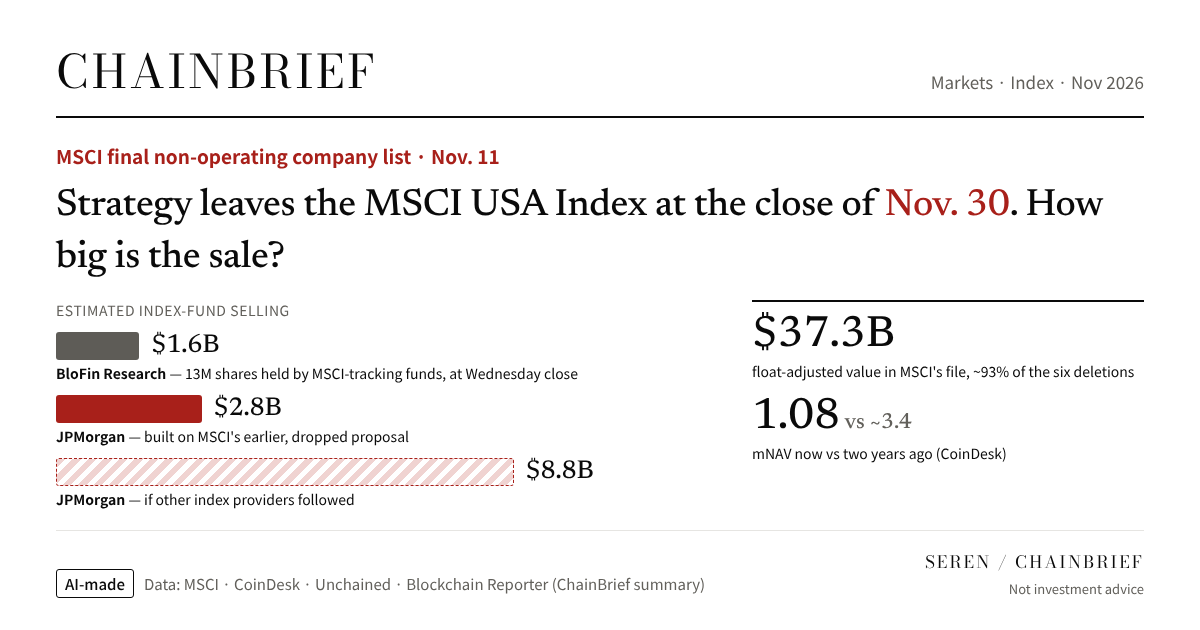
Strategy dwarfs the rest. Blockchain Reporter puts its float-adjusted market value in MSCI's file at about $37.3 billion, roughly 93% of the six deletions combined. In MSCI's trial run on May data, the same figure was $23.9 billion. The gap reflects the newer measurement date, Oct. 20, not a change in the rule.
The rule itself never mentions bitcoin. MSCI first checks whether a company has substantial operating assets. Those that fail are scored on five financial ratios, and four red flags make a company ineligible. Existing index members get extra room: they are removed only after failing in each of their two most recent annual filings. Strategy failed twice. The financial data used here run to Sept. 30.
The decision also retires a stopgap. In October 2025 MSCI had floated a narrower measure aimed at companies holding 50% or more of their assets in digital assets. That interim approach ends with this November review, according to Unchained and Blockchain Reporter.
The sale in dollars, three ways
The number most often quoted is $2.8 billion, from JPMorgan analysts. It needs a footnote. Unchained and CoinDesk both note that JPMorgan built the estimate in late 2025 around MSCI's earlier digital-asset proposal, the one MSCI later dropped. The same analysts said selling could reach about $8.8 billion if other index providers followed.
Strategy's own figure is smaller. In its response to MSCI, the company said funds tracking MSCI indexes hold about 13 million of its shares, or 3.1% of basic shares outstanding, and that this is less than one day's trading volume. BloFin Research, cited by CoinDesk, priced those 13 million shares at about $1.6 billion at Wednesday's close.
For scale, $1.6 billion is close to four times the roughly $430 million that US spot bitcoin ETFs lost on Nov. 5, the worst day of their current outflow run. The difference is that index funds trade on a known date, at a known time.
Not every fund that tracks MSCI will have to sell the full amount. Markus Thielen of 10x Research told CoinDesk that many funds already hold Strategy below its benchmark weight, so the pressure may be lighter than the headlines suggest. Blockchain Reporter added that MSCI's file publishes no weights or flow forecasts, so nobody can size the trade precisely from it. Funds benchmarked to S&P, FTSE Russell or CRSP indexes are not affected by this decision.
The stock barely blinked at first. Strategy closed Wednesday's regular session at $122.35, up about 1%, before the list came out. After hours it slipped. Bitcoin Magazine had it down 1.5% at $120.50 shortly after 5:30 p.m. ET, Cointelegraph reported a 1.65% fall, and The Block cited a 2.6% drop to $119.06. Those figures were taken at different times and do not agree, which is normal for thin after-hours trading.
Why the premium matters more than the trade
Strategy has always argued that its bitcoin is the business. Michael Saylor and chief executive Phong Le called MSCI's approach to digital asset treasury companies discriminatory, according to The Block, and the company told MSCI that removal would not seriously hurt its operations but would damage MSCI's standing as a neutral index provider.
The real exposure is to the way Strategy raises money. It buys bitcoin by selling common stock, preferred shares and convertible notes. That works best when the shares trade well above the value of the bitcoin behind them, a ratio the market calls mNAV. CoinDesk puts that ratio near 1.08 now, against about 3.4 two years ago. With the premium that thin, each new share sold buys only a little more bitcoin per share than the company already holds.
Last week's filing shows the squeeze. In the seven days to Nov. 8, Strategy sold 2.05 million common shares for $283.8 million. Only $81.9 million went to bitcoin, buying 1,036 coins. Another $188.3 million went to buying back its STRC preferred stock, and the company reported $4.77 billion in cash, according to CoinDesk and The Crypto Desk newsletter.
There is a second pressure point. Bitcoin Magazine puts Strategy's average cost at $75,456 per bitcoin. Bitcoin traded around $73,400 on Thursday morning UTC, according to two daily market reports. At that price, the company's coins are worth a little less than it paid for them.
Critics of the treasury model see the MSCI exit as overdue. Independent analyst Derin Olenik, quoted by CoinDesk, said the removal undercuts the institutional-adoption story the model depends on, and argued these companies need operating businesses rather than pure accumulation. Thielen's view was that they should start behaving more like asset managers.
None of this forces Strategy to sell a bitcoin. The index decision moves its shares, not its coins.
What happens before Nov. 30
MSCI can still adjust the list for corporate events before it takes effect, according to Unchained and Blockchain Reporter. The watchlist names, SharpLink among them, are due for another look in the February 2027 review, Blockchain Reporter reported.
The index funds' orders will go through at the US market close on Monday, Nov. 30, the same session in which Metaplanet, Upexi and Yellow Cake leave their own MSCI indexes.
This article is for information only and is not investment advice.
Sources
- MSCI · Final impact list of the non-operating companies methodology (Nov. 11, 2026)
- The Block · Strategy, Metaplanet lose MSCI index membership in November reshuffle
- Bitcoin Magazine · MSCI removes Strategy (MSTR) from its index
- Cointelegraph · MSCI confirms Strategy, Metaplanet index removals
- Unchained · Strategy to leave MSCI indexes by month end, Metaplanet also out
- CoinDesk · MSCI is dropping Strategy from its index