
MSCI’s list of ‘non-operating’ companies is due, and Strategy is the $24 billion test case
MSCI is set to name the companies that fail its new test for businesses that mostly hold assets rather than run operations. Strategy accounted for about 87% of the market value flagged in MSCI’s own trial run, and any removal takes effect at the close of Nov. 30.
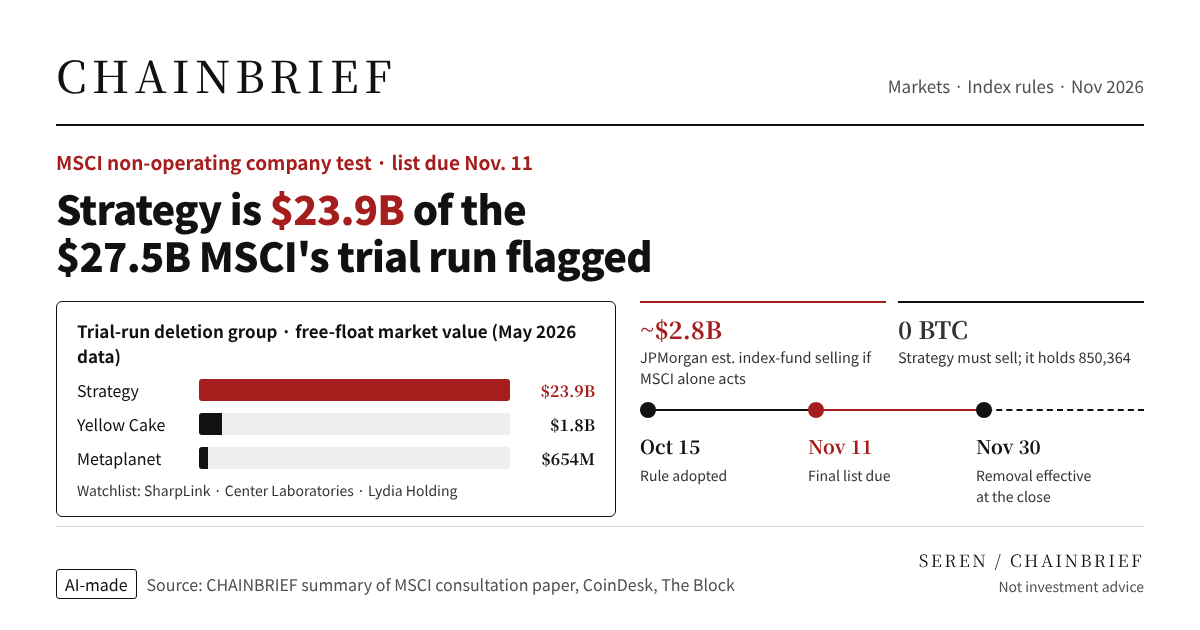
In MSCI's trial run of its new rule, six companies were flagged. Their combined free-float market value came to about $27.5 billion, and one of them, Strategy, made up nearly $24 billion of it. On Wednesday, Nov. 11, the index provider is scheduled to publish the real list, the one that decides which of those names leave its global benchmarks at the close of Nov. 30.
Removal would not make Strategy sell a single bitcoin. It holds 850,364 BTC after last week's purchase. What it would do is force index funds tracking MSCI benchmarks to sell Strategy shares. JPMorgan analysts put that selling at about $2.8 billion if MSCI alone acts, and more if other index providers adopt similar rules.
A test built around the balance sheet
MSCI adopted the framework on Oct. 15, after a consultation that ran through Sept. 30. CoinDesk and Decrypt both described the final version as close to what MSCI proposed in August. The rule does not mention bitcoin. It asks a broader question: is this company mainly running a business, or mainly holding assets?
The first step is a single screen. If operating assets make up more than half of total assets, the company is fine and the test ends there. If not, MSCI runs five ratios, according to its August consultation paper. They measure how much of the balance sheet is tied to operations, how much the company spends running itself, whether operating cash flow is negative, how much of its results come from changes in the fair value of non-operating holdings, and how much of its money comes from raising capital to buy more assets. Trip four of the five and the company is ineligible.
Existing index members get two kinds of slack. Their thresholds are looser on two of the ratios. And they are removed only after failing in each of their two most recent annual filings. A company that fails once lands on a public watchlist and gets another year.
The trial run, based on May 2026 data, put three companies in the deletion column: Strategy, with about $23.9 billion of free-float market value, the London-listed uranium holder Yellow Cake at $1.8 billion, and Japan's Metaplanet at $654 million. SharpLink, Center Laboratories of Taiwan and Lydia Holding of Turkey went on the watchlist. The Block reported the same figures from MSCI's paper in August.
The October decision also ended a stopgap. In October 2025, MSCI had floated a simpler idea aimed at companies holding digital assets worth 50% or more of their total assets. In January it said it would not exclude them for the time being and would look at the issue more broadly. This new test is the result.
Strategy's case: its bitcoin is the business
Strategy fought the rule throughout. In an Aug. 31 letter to MSCI's index committee, reported by Stocktwits and CryptoPotato, the company argued that its bitcoin activity is an operating segment under U.S. accounting rules, a reading it said was consistent with discussions with SEC staff. It said the labels "operating" and "non-operating" have no basis in any relevant accounting standard. It also noted that it alone made up roughly 87% of the market value at stake across the six flagged companies, which fits MSCI's own table. Its request was blunt: "MSCI should withdraw the proposal."
The company's accounts do show how blurry the line is. Strategy reported operating income of $20.91 billion for the third quarter, according to its Oct. 29 results as covered by BitcoinTreasuries and KuCoin News. Almost all of it came from the rising value of its bitcoin, because the company books those gains inside operating results. That is exactly what one of MSCI's ratios is designed to catch: earnings that come mostly from marking up held assets rather than from selling products.
MSCI's side of the argument is that index members should be companies whose returns come from running a business, and that investors who want exposure to a pool of assets can buy funds built for that. Funds, investment trusts and business development companies are already ineligible for its equity indexes because of their legal form. The new screen extends that logic to corporations that behave like funds. In its consultation paper, MSCI said only a sustained change in business structure would move a company between the categories, not a one-off miss.
Who would actually sell
Passive funds do not get a vote. A fund tracking an MSCI benchmark must hold what the index holds, so a deletion turns into an order to sell by the effective date. JPMorgan's $2.8 billion figure is the one most widely cited across CoinDesk, Bitcoin.com News and The Block. For scale, that is well above the roughly $1.6 billion that all U.S. spot bitcoin ETFs together have lost to redemptions so far this November, by Bitcoin.com News' count of SoSoValue data.
Some of that selling may already be in the price. Strategy shares closed at $151.29 on Oct. 15, the day MSCI made its decision, according to CoinDesk and Bitcoin.com News. That was about 72% below the record of roughly $543 set in November 2024. The stock has fallen further since, along with bitcoin, which hit its lowest level since late August on Tuesday after a hotter-than-expected U.S. inflation report.
The harder question is what removal does to Strategy's main tool. The company has paid for its bitcoin mostly by selling new common shares, preferred stock and convertible debt. Index funds have been dependable holders of those shares. A smaller pool of automatic buyers makes each new share sale a little harder to place, though nothing in the MSCI rule limits how much the company can raise.
There is also a timing wrinkle. Under MSCI's rule, a current member must fail in both of its latest annual filings before it is deleted. The trial run already placed Strategy in the deletion group rather than on the watchlist. That suggests it fails on both years, unless the final calculation differs from the May test.
What happens after Wednesday
If Strategy and Metaplanet are on the list, the change takes effect after the market close on Nov. 30, as part of MSCI's November index review. Index funds usually do most of their selling near that close, so the heaviest trading in Strategy shares is likely to come on Nov. 30 itself, a Monday.
MSCI is not the only index company that matters. Strategy also sits in the Nasdaq-100, and FTSE Russell and S&P Dow Jones Indices apply their own eligibility rules. JPMorgan's larger outflow scenarios rest on those providers following MSCI's lead.
Until then, the list is the only new fact. The selling comes 19 days later.
This article is for information only and is not investment advice.
Sources
- MSCI · Consultation on Eligibility of Non-Operating Companies for the MSCI Global Investable Market Indexes (Aug. 2026)
- CoinDesk · MSCI makes it official, and bitcoin treasury firms Strategy, Metaplanet are on notice
- Decrypt · Bitcoin Treasury Giant Strategy Faces Index Removal Under Finalized MSCI Rules
- The Block · Strategy, Metaplanet could face MSCI index removal under new proposal
- Stocktwits · Strategy calls MSCI's new delisting test 'fundamentally flawed'
- Bitcoin.com News · MSCI Just Put Saylor's Strategy on the Road out of Its Global Indexes