
Coinbase wins final OCC trust charter, moving its crypto custody under federal watch
The Office of the Comptroller of the Currency has given final approval to Coinbase National Trust Company, putting the largest U.S. exchange’s custody arm under a federal bank regulator. It will not take deposits or make loans, and community banks are still in court trying to stop charters like it.
In FocusPolicy & Regulation20 flashes · 13 stories
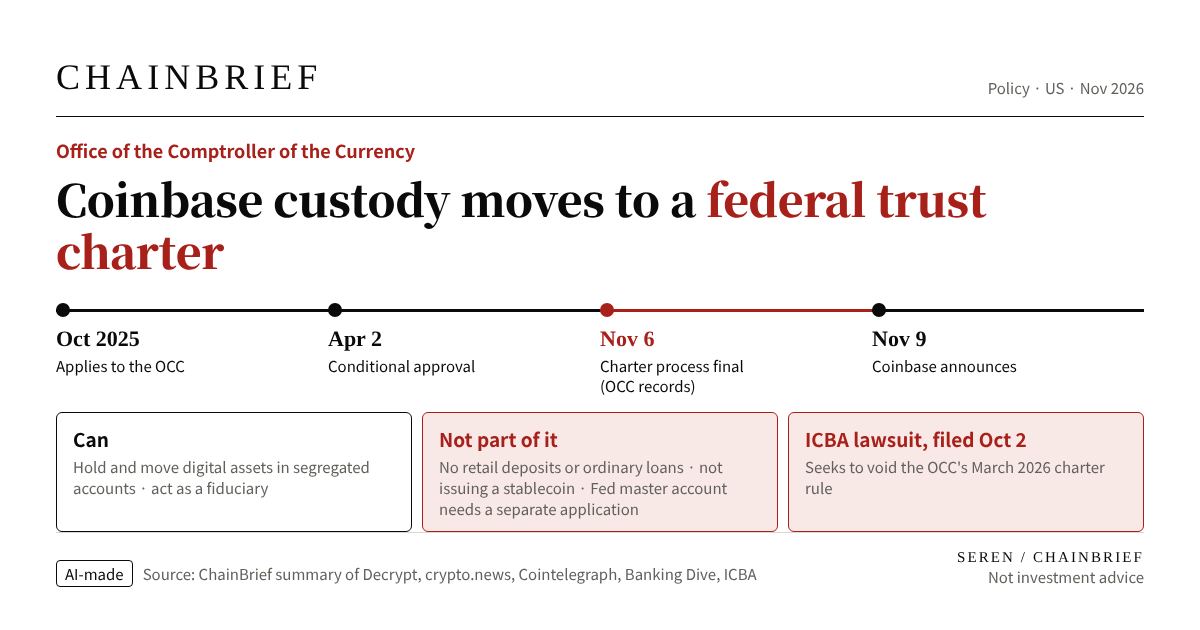
For eight years, the bitcoin that Wall Street firms parked with Coinbase sat in a trust company supervised by New York State. On Monday, Coinbase said that arrangement is moving to Washington. The Office of the Comptroller of the Currency, the Treasury bureau that charters national banks, has signed off on Coinbase National Trust Company, the last step in a process that began with an application in October 2025.
OCC licensing records show the charter process finished on Friday, Nov. 6, according to crypto.news and Cointelegraph. Coinbase made the announcement on Nov. 9. The approval had been conditional since April 2, when the OCC said yes in principle but required the company to finish building out the bank before it could open.
A bank that won't take your paycheck
The word "bank" in a national trust charter does a lot less work than most people expect. Coinbase's new entity can hold and move digital assets for clients in segregated accounts and act as a fiduciary, meaning it is legally bound to put clients' interests first. It cannot take retail deposits, make ordinary loans or lend out customer money the way a commercial bank does. It is also not issuing a stablecoin.
The company was blunt about that back in April. "Coinbase is not becoming a commercial bank," Greg Tusar, a Coinbase executive, told Banking Dive at the time. Staking, financing and prime brokerage will keep running through other Coinbase companies, with the trust bank acting only as the custodian that holds the assets underneath.
The charter also does not hand Coinbase a direct line into the Federal Reserve's payment system. A Fed master account requires its own application and review, and that is a separate fight several crypto firms are still having.
What changes, then, is who checks the vault. Under the old setup, Coinbase Custody Trust Company answered to the New York Department of Financial Services. A national charter brings one federal rulebook that applies in every state, which matters to pension funds, ETF issuers and corporate treasuries that would rather not reconcile 50 state regimes. Coinbase plans to shift its existing New York custody business into the national entity gradually over three years, according to crypto.news and The Cryptonomist.
That client list is not small. Coinbase holds the coins for many U.S. spot bitcoin ETFs, BlackRock's IBIT among them. Those funds lost about $1.28 billion to redemptions last week, a reminder that the custodian's books move every trading day.
The crypto charter queue
Coinbase is not first in line. Circle received final approval for its national trust bank in July, a vehicle for holding USDC reserves. Ripple followed on Oct. 26 with Ripple National Trust Bank, which will hold reserves for its RLUSD stablecoin and offer custody. BitGo, Fidelity Digital Assets and Paxos have also moved through the OCC's process, while Crypto.com and Stripe's stablecoin firm Bridge hold conditional approvals and Kraken's parent is still waiting, according to Cointelegraph and Decrypt.
The pace is new. Under Comptroller Jonathan Gould, the OCC loosened its stance on crypto firms in 2025 and finalized a chartering rule in March 2026 that took effect April 1. When Coinbase won conditional approval in April, Banking Dive counted it as the eighth crypto-linked firm to get a conditional national trust charter since December 2025. A lawsuit filed in October by community banks puts the total at 21 national trust charters approved or conditionally approved under the current administration, at least 13 of them for crypto companies, according to a summary of the complaint by the law firm Ballard Spahr.
Community banks want the door shut
That lawsuit is the main threat hanging over the whole group. The Independent Community Bankers of America sued the OCC in federal court in Washington, D.C., on Oct. 2, arguing that the National Bank Act lets the agency charter trust banks only to do fiduciary work, not to give crypto custodians and payment firms a federal license with fewer obligations than a deposit-taking bank. ICBA's chief executive, Rebeca Romero Rainey, has framed the charters as a back way into the banking system.
The suit asks the court to throw out the OCC's March 2026 rule and an interpretive letter the agency relies on, and to cancel one specific conditional charter, for a company called Protego Holdings. It does not ask the judge to revoke charters already granted to Coinbase, Circle or Ripple. But if ICBA wins on the rule itself, the legal basis for the next wave of approvals would be in doubt, and existing holders would face pressure to justify their status.
Bank groups also make a practical complaint. Small banks spend heavily on compliance to keep a deposit charter. ICBA's filing says two of its member banks, each under $2.5 billion in assets, spend more than $1.5 million a year on it. A trust bank that never takes insured deposits skips much of that. And if one fails, ICBA notes, the OCC would be running an uninsured bank receivership, something it has not done in nearly a century.
Coinbase's argument runs the other way. Its executives say a federal charter means more oversight, not less: OCC examiners on site, capital and liquidity rules, and a single standard in place of a patchwork. For institutional clients deciding where to keep billions in bitcoin, that is the point of the exercise.
Politics shift in January
The approval lands a week after Democrats won both chambers of Congress in the midterm elections. That does not reach the OCC directly; the Comptroller is an executive branch appointee and the charters are agency decisions. It does change who runs the hearings. Senator Elizabeth Warren, the senior Democrat on the Senate Banking Committee, has argued the OCC's crypto approvals, Coinbase's included, are unlawful, Decrypt reported. Oversight letters, subpoena threats and questions to Gould become easier to issue once the gavels change hands in January.
There is also a statutory clock. The GENIUS Act, the stablecoin law signed in July 2025, takes effect on Jan. 18, 2027, or 120 days after regulators finish its implementing rules, whichever comes first. Trust charters are one of the routes firms are using to fit their stablecoin and custody businesses under that law, which helps explain why so many applications have landed at the OCC in the past year.
For Coinbase customers, nothing changes this week. Retail accounts stay where they are, and the custody migration from the New York trust company will run in stages. The next date that could alter the picture belongs to the courts: the OCC's answer to ICBA's complaint in the D.C. federal case, and then a judge's view of whether a crypto custodian can be a national bank at all.
This article is for information only and is not investment advice.
Sources
- Decrypt · Coinbase Joins Circle, Ripple With Final OCC Approval for Federal Trust Bank Charter
- crypto.news · Coinbase wins full US banking approval, but with key restrictions
- Cointelegraph · Coinbase Receives OCC Approval for National Trust Bank Charter
- Banking Dive · Coinbase nabs conditional OCC charter approval
- ICBA · ICBA Sues OCC Over National Trust Bank Charters for Crypto Firms
- Consumer Finance Monitor (Ballard Spahr) · ICBA sues OCC over crypto national trust bank charters