
Bitcoin ETFs slip into the red for 2026 after a $1.28 billion week of withdrawals
U.S. spot bitcoin funds lost $1.28 billion in the first week of November, their worst run since June, and are now net sellers for the year. BlackRock’s IBIT accounted for most of the money that left.
Coins mentionedBTC——
In FocusETF Flows16 flashes · 2 stories
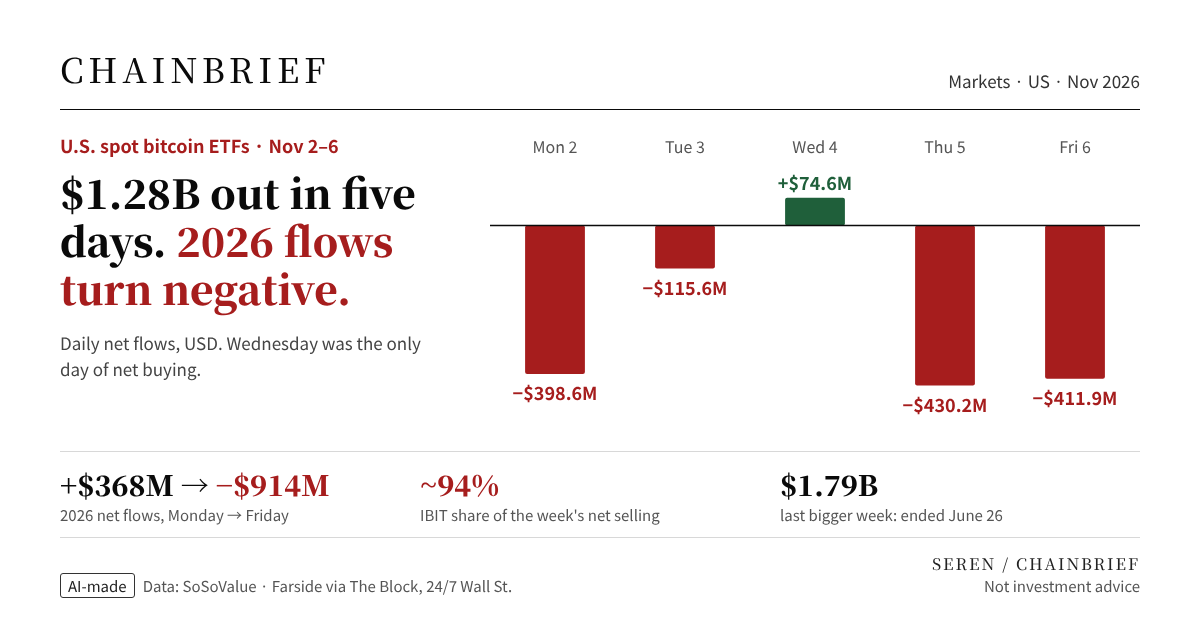
On Monday morning, U.S. spot bitcoin ETFs were still up about $368 million for 2026. By Friday's close they were down $914 million. Five trading days, one week after the midterm elections, erased every dollar the funds had gathered since January and then some.
The net outflow for the week of Nov. 2 to Nov. 6 came to roughly $1.28 billion, according to flow data from SoSoValue and Farside Investors. It was the funds' second losing week in a row and the heaviest since the week ended June 26, when about $1.79 billion left. The Block counts it as the seventh-largest weekly outflow since the products launched in January 2024.
Four red days out of five
The selling was spread across the week rather than concentrated in a single panic. Investors pulled about $398.6 million on Monday and $115.6 million on Tuesday. Wednesday brought the only net buying, about $74.6 million, on a day when U.S. stocks bounced. Then came the two worst sessions: about $430.2 million out on Thursday and $411.9 million on Friday.
Bitcoin itself fell about 5.6% on Thursday alone and briefly traded below $75,000 on Friday, with 24/7 Wall St. putting the intraday low at $74,722. By Saturday morning it sat near $75,900, about 13.5% lower than where it began the year.
For scale, $1.28 billion is around 1.3% of the roughly $95.9 billion in bitcoin the 12 U.S. funds hold between them. That is not a run on the products. It does mean the money that arrived in the autumn, which pushed year-to-date flows back above zero in late September, has gone back out.
The week before was not much better. Funds lost about $202.6 million in the last week of October, and the Friday of that week, Oct. 30, saw $643.3 million leave in one session, the biggest single day of withdrawals in four months.
One fund did most of the selling
BlackRock's iShares Bitcoin Trust, IBIT, was at the center of it. On Friday it shed about $403 million on its own, while Bitwise's BITB, the Ark and 21Shares fund ARKB and Grayscale's GBTC each lost between $11 million and $21 million. Fidelity's FBTC went the other way that day, taking in about $42.8 million, after leading Thursday's outflows with roughly $199.9 million.
24/7 Wall St. puts IBIT's share of the week's net selling at about $1.21 billion, or 94%. IBIT is the largest of the group by a wide margin, so heavy selling there usually reflects big allocators trimming rather than a scattering of small accounts. Even after the week, IBIT holds about $60.3 billion in net assets, with cumulative inflows of $65.1 billion since launch, according to The Block.
The election, AI stocks and a hacked exchange
No fund manager has publicly given a reason for the withdrawals, so the explanations come from analysts and reporters reading the tape.
The most common one is politics. Democrats won control of both chambers of Congress in Tuesday's midterms, and The Block and CoinCentral both tied the slide to that result. The industry spent heavily during the campaign to defend a friendly Congress, and the market-structure bill known as the Clarity Act, which stalled in the Senate in September, now has only the lame-duck session left before new committee chairs take over in January.
The second explanation has little to do with crypto. Doubts about the payoff from artificial intelligence spending hit tech stocks during the week, and bitcoin ETFs sit in the same brokerage accounts as those stocks. 24/7 Wall St. argued that when advisers sell growth, the bitcoin sleeve often goes with it, and pointed to Wednesday, when stocks recovered and ETF buyers returned for exactly one day. Tech analyst Beth Kindig added a macro angle on X, writing that the dollar was strengthening again and bond yields were climbing, both of which tend to weigh on assets that pay no interest.
The third is the Binance hack. Roughly $6.3 billion was taken from the exchange on Oct. 29 in an attack the FBI has attributed to North Korea's TraderTraitor group. Binance says it has replenished most of the stolen assets and has been reopening withdrawals in stages, but blockchain analytics firm Elliptic reported late in the week that the attackers have now converted about $175 million of other stolen tokens into roughly 2,300 bitcoin. The hack does not touch the ETFs directly, since their coins sit with custodians such as Coinbase. It has, however, hung over sentiment since the record Oct. 30 outflow.
Not everyone reads the week as a turning point. CoinCentral cited CryptoQuant data showing short-term holders, people who bought in the past few months, sending far more coins to exchanges at a loss than at a profit, a pattern some analysts associate with late-stage selling. The same outlet also noted a warning from Arthur Hayes, co-founder of Maelstrom, that a collapse in AI stocks could drag bitcoin lower. The data can be read either way.
Ether funds have it worse
The pain was broader than bitcoin. U.S. spot ether ETFs lost about $365.3 million in the week, their sixth losing week in a row, with Wednesday again the only day of net buying. Since late September they have given back about $2.02 billion and are now roughly $405.6 million in the red for 2026, The Block reported. BlackRock's ETHA accounted for about $90.8 million of Friday's ether outflows.
Smaller products followed the same pattern. Solana ETFs recorded a fifth straight losing week, about $26.3 million out, though they remain around $676 million positive for the year. XRP funds, which hold about $1.34 billion, saw no new money at all from Nov. 3 to Nov. 6, according to 24/7 Wall St.
For a group of products sold to Wall Street as the easy on-ramp for institutional money, a negative year would be an awkward result. There are fewer than eight weeks of trading left in 2026 for the bitcoin funds to recover roughly $914 million. The first read comes with Monday's flow report, followed later in the week by U.S. inflation data that will shape how bond yields, and with them risk appetite, move into December.
This article is for information only and is not investment advice.
Sources
- The Block · Bitcoin ETFs flip negative for 2026 after $1.28 billion outflow week, worst since June
- 24/7 Wall St. · Bitcoin ETFs Shed $1.3 Billion in a Week and XRP ETFs Saw Zero Inflows
- CoinCentral · Worst ETF Outflow Week Since June Pushes BTC Under $76K
- crypto.news · Bitcoin price holds $76K as ETF outflows put $75K support in focus
- CoinTurk News · Elliptic reports Binance hack attackers swapped $175 million for 2,300 BTC