Fifty companies say no to OKX-ICE tokenized stocks as first opt-out window closes
Nvidia, Costco and Nike are among 50 issuers that have barred their shares from a planned 24/7 tokenized stock venue run by OKX and NYSE owner ICE. The first 30-day objection window under the SEC’s new exemption runs out around today.
In FocusTokenization & RWA2 flashes · 3 stories
Top image: AI-made graphic (article data)
Sixty-two companies were on the list when OKX and Intercontinental Exchange unveiled their plan to trade blockchain versions of U.S. stocks around the clock. Four weeks later, 43 of them have formally told the venue to leave their shares alone.
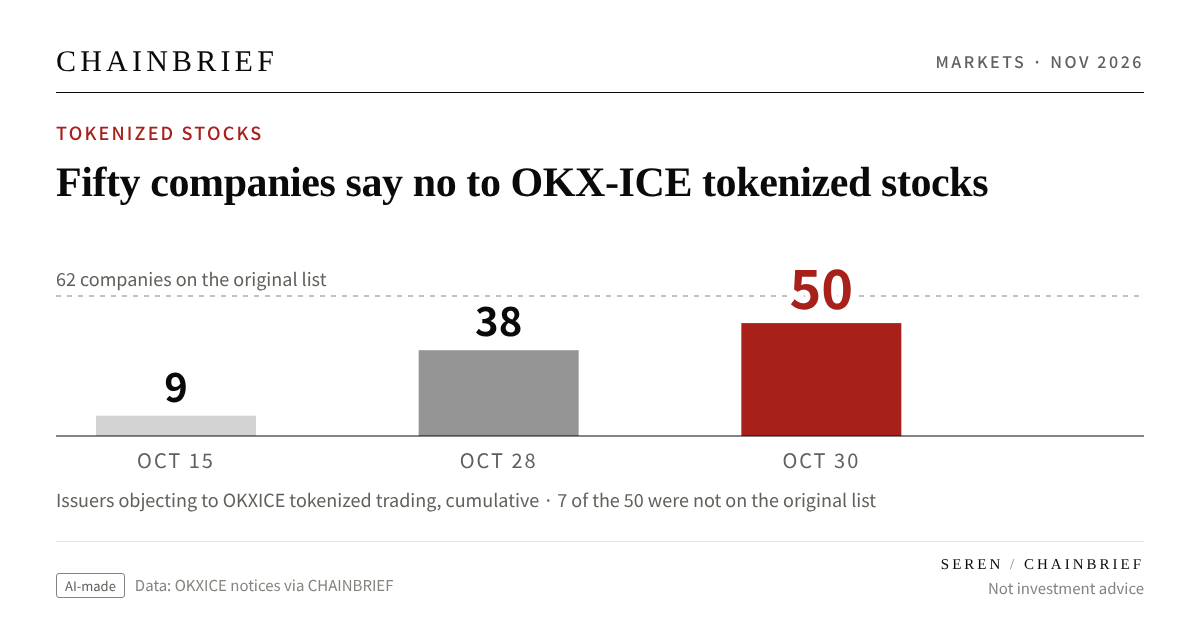
The latest notice from the joint venture, OKXICE, dated Oct. 30, put the total number of objecting issuers at 50. Twelve were new that day, including Nvidia, Costco, Nike, Micron, CrowdStrike, Palo Alto Networks, Reddit and Hewlett Packard Enterprise. Seven of the 50 were never on the original list and objected anyway. The count has climbed fast: nine names on Oct. 15, 38 on Oct. 28, then 50 two days later.
The timing matters because the opt-out right is short. For companies that received OKXICE's notice on Oct. 4, the 30-day window to object closes around Tuesday, Nov. 3. Once it lapses, the SEC's order offers no second chance.
A five-year exemption with a 30-day veto
The venue exists because of an SEC order that took effect on Sept. 17, which the agency under Chairman Paul Atkins calls an "innovation exemption." It lets qualifying tokenized securities venues trade on-chain versions of listed U.S. stocks without registering as exchanges, and it lets their liquidity providers skip dealer registration. The relief runs for five years, to Sept. 17, 2031. Atkins has described it as a bridge, saying it must be followed by permanent rulemaking.
The exemption came after the Clarity Act, the market-structure bill that would have written crypto rules into law, stalled in the Senate in September.
The issuer veto sits at the center of the design. If a company tokenizes its own shares, the venue owes it nothing. If an unaffiliated third party does the tokenizing, as in the OKXICE model, the venue must send written notice to the company's head office and wait at least 30 calendar days. A written objection inside that window bars that stock from that venue. It does not block the stock anywhere else.
The SEC also boxed in how big these venues can get. Large companies, mostly S&P 500 and Russell 1000 members, fall into a first tier capped at 75 symbols per venue group. Trading in any one of those stocks cannot exceed 0.25% of its average daily volume on the consolidated tape over the prior month. For a stock that trades $10 billion a day, that is a ceiling of roughly $25 million. Smaller companies get more room: up to 250 symbols and a 2.5% cap.
Venues also do not count as exchanges under Regulation NMS, the rulebook that requires brokers to route orders to the best displayed price. They must instead publish dollar trade data within 10 minutes of each trade and halt a stock whenever its listing exchange halts it.
What OKX and ICE are building
OKXICE is a 50-50 venture between ICE, which owns the New York Stock Exchange, and a U.S. holding company of crypto exchange OKX. It was formed in June, about three months after ICE bought a minority stake in OKX at a $25 billion valuation. Former New York Governor Andrew Cuomo is its co-chair.
The plan is to run trading through permissioned Uniswap v4 liquidity pools on X Layer, OKX's own blockchain network. Each stock token would trade against a stablecoin: USDC, USDG or Tether's USDT. Only wallets holding a non-transferable access token can trade, and OKX's U.S. arm issues that token after identity, anti-money-laundering and sanctions checks.
An unnamed third party, called the Tokenizer in the filing, would hold the real shares one-for-one through a registered broker-dealer. Token holders are supposed to receive the same dividends and voting rights as ordinary shareholders.
No launch date has been set. Prices come only from the pools, so they could drift from the listed share price, especially on weekends and overnight when the main markets are shut.
Why so many issuers said no
None of the objecting companies has explained its decision in public. The one major exchange operator to give a reason is Nasdaq. It opted its own shares out and told The Wall Street Journal it would not have its stock on a venue that does not show the best prices in real time or report trades to the consolidated tape.
Nasdaq's role may go further. Journalist Eleanor Terrett counted 23 Nasdaq-listed companies among the first 38 objectors. Another reporter, Jacquelyn Melinek, cited an executive at a Nasdaq-listed company who said an exchange representative had suggested filing. Nasdaq declined to comment on that account, and it denied any part in a newspaper advertisement urging chief executives to opt out.
Nasdaq is not against tokenization itself. It is building what it calls the Nasdaq Equity Token, a model run with the cooperation of issuers inside the existing market framework, and is working with Kraken on a separate tokenized product aimed at the second quarter of 2027. It has said it will not run a venue under the temporary exemption.
Some objectors frame their move as caution rather than rejection. JPMorgan Chase, an early objector, told CoinDesk it still sees promise in the technology but wants care over how its shares are represented and traded. Cuomo, speaking to reporters last week, said companies had been expected to wait and watch. "We are at the very beginning of the rollout of fundamentally different market structure," he said.
The 19 that stayed quiet
The more telling list may be the one without objections. Nineteen of the original 62 had not filed one as of the Oct. 30 notice, according to a CoinDesk tally. They include Apple, Amazon, Tesla, SpaceX, Netflix, Palantir, Boeing and Home Depot, alongside crypto-linked names such as Coinbase, Circle, Robinhood and Strategy.
Silence is not the same as a yes. Venues have up to five business days to publish objections, so a filing made near the deadline may not show up yet. Of the 19, only Securitize and BitGo have said they did not plan to object.
Even so, the split already gives OKXICE a shape. If every remaining name stays, the opening menu would mix household consumer and tech names with crypto-linked companies, minus most of the big chipmakers and banks that have opted out.
There is also the other door the SEC left open. A company can sponsor its own tokens and skip the 30-day notice altogether. Canton Strategic Holdings, a small Nasdaq-listed firm, has filed to do exactly that on a separate venue run by TSV LLC on the Canton Network, with registered transfer agent Fairmint keeping the on-chain shareholder record.
That issuer-led route is the one Nasdaq favors, and it is the reverse of the OKXICE approach of building a market first and asking companies to opt out. The next updated OKXICE notice, due within five business days of any late filings, will show how many of the 62 actually stay on the list.
This article is for information only and is not investment advice.
Sources
- CoinDesk · Nvidia, Costco and Nike join OKX–ICE tokenized stock objections, bringing total to 50
- Decrypt · Nvidia and Nike Lead Biggest Wave Yet of Tokenized Stock Objections
- Decrypt · OKX and NYSE Owner ICE Plan 24/7 Tokenized Stock Trading Under SEC Exemption
- Sidley · SEC Issues "Innovation Exemption" for On-chain Trading of Tokenized U.S.-Listed Stocks
- crypto.news · Nasdaq and the OKXICE tokenized stock objections
- Unchained · Canton Strategic Holdings Moves to Tokenize Its Own Shares Under the SEC's New Exemption